
How to train toddler sleep: the best method for your toddler


Learning how to guide your toddler toward restful, independent nights is a common challenge during the early years. This article explains the essentials of toddler sleep training: recognizing readiness, building a consistent schedule, choosing an approach that suits your family, and using helpful tools at every step.
When to sleep train a toddler
Sleep training a toddler differs from managing a newborn’s sleep. At ages 2 and 3, children have more language, stronger separation anxiety, and a growing ability to test boundaries. Understanding this stage helps you select the right moment and method before the first bedtime. For a detailed overview of toddler sleep training methods and age-specific strategies, see the toddler sleep training guide.

Signs your child is ready
Knowing how to train your toddler’s sleep begins with recognizing signs of readiness. One useful indication is the ability to fall asleep at bedtime without prolonged help on some nights, showing that independent settling is beginning to emerge. Other signs include understanding simple instructions, being able to stay in bed briefly without immediate distress, and responding to clear explanations about bedtime expectations.
When these signs appear consistently, a structured sleep plan can build on that foundation. Before you start, rule out illness, teething discomfort, or a major family disruption, because consistency supports every approach.
Prepare for consistent nights
If you are considering sleep training your toddler at 18 months, remember that this age is a developmental crossroads. Language is emerging, separation anxiety may intensify, and sleep cycles are still maturing. A structured approach can prevent habits from becoming firmly established, but all caregivers need to agree on the plan first.
Decide together which boundaries you will set and how you will respond to crying, bedroom exits, or repeated calls. Mixed responses between caregivers are a common reason progress stalls.
- Choose the right timing. Avoid starting during travel, a house move, the arrival of a new sibling, or another period of significant family stress that affects the daily rhythm.
- Protect two clear weeks. Choose a period when naps can take place at the same time and in the same location each day, while your household schedule stays relatively stable.
- Explain the change simply. Tell your toddler in plain language what will happen at bedtime. Offer small choices, such as selecting pajamas or a comfort object, so they retain a sense of control.
- Track progress from day one. Record bedtime, the time needed to fall asleep, the number of night calls, and morning rising for several days. This information helps you assess progress and adjust the sleep plan.
Small decisions, such as choosing new bedsheets or the color of a nightlight, can give your toddler a sense of ownership without making the sleep boundary negotiable. The routine may feel personal and warm, while the expectation to stay in bed remains clear.
Tools such as the smart sleep trainer for toddlers REMI provide a concrete visual cue: a friendly sleeping face that shows when it is time to stay in bed. This can make the boundary easier to understand without requiring repeated reminders.
Research on the effectiveness of behavioral sleep interventions indicates that structured approaches can reduce child sleep problems without significant adverse effects on emotional development or parent-child attachment. This evidence may reassure families who are uncertain about sleep training a toddler.
For guidance on choosing a toddler sleep trainer, a professional assessment is a reliable starting point when family circumstances are complex. With a consistent bedtime, a predictable routine, and an approach you can maintain, you can help your toddler fall asleep more independently and move toward calmer nights.
Set a schedule that supports sleep
Before any sleep training method can succeed, your toddler’s daily rhythm needs to match their biological sleep needs. An ill-timed nap, a late bedtime, or inconsistent wake-up times can undermine even a carefully planned approach. A stable sleep schedule is not a secondary detail; it provides the structure that helps your child fall asleep and stay asleep.
Match naps and bedtime
Most children have moved to one nap lasting one to two hours in the early afternoon, ideally after lunch. Awake periods between sleep phases usually last four to five hours. A nap that runs too long or begins too late can push natural sleepiness beyond the best bedtime window, making it harder for your child to fall asleep regardless of the method you choose.
Children who go to bed before 9 p.m. may sleep up to one hour and twenty minutes more each night and fall asleep faster than children with consistently later bedtimes, according to data on toddler sleep patterns. For most 2-year-olds, a bedtime between 7:30 and 8:30 p.m. allows approximately 30 minutes to settle. A later bedtime does not usually lead to a later morning wake-up; instead, it can reduce overall sleep quality and worsen mood, attention, and daytime behavior.
| Age | Total daily sleep | Nap duration | Awake window | Ideal bedtime |
| 2 years | 12–16 hours | 1–2 hours (early afternoon) | 4–5 hours | 7:30–8:30 p.m. |
| 3 years | 11–14 hours | 1 hour or transitioning out | 5+ hours | 7:30–8:30 p.m. |
Create a sleep-ready bedroom
Parents who want to sleep train a toddler at night should consider the bedroom environment carefully, because it influences how quickly and consistently progress develops. If the room is dark and quiet at 8 p.m. but brightens at dawn, sleep cycles close to morning may be disrupted, increasing the likelihood of early waking.
- Darkness The room should be dark enough at nap time and bedtime that moving around would be difficult without a light source. Blackout solutions can prevent early morning light from shortening night sleep.
- Sound A consistent, low-level sound such as white noise can mask household activity and maintain a steady auditory environment through the sleep cycles.
- Safety Anchor furniture to the walls, remove accessible hazards, and consider a door gate so the room remains secure if your toddler leaves bed during the night.
Outdoor play and exposure to natural light during the day help regulate your child’s circadian rhythm. Limiting screen time during the hour before bed also reduces blue-light interference with melatonin production. Notice signs of tiredness, including yawning, eye rubbing, lower energy, and increasing irritability, then begin the wind-down routine before overtiredness develops. An overtired child is often harder to settle and more likely to wake during the night, which can weaken the consistency your sleep training plan requires.
Build a toddler bedtime routine
A predictable sequence of calm, repeatable steps is the most universal element across toddler sleep training approaches. The routine does not make your child asleep by itself; instead, it signals that sleep is approaching, lowers physiological arousal, and meets the emotional need for connection and security that many toddlers express most strongly at the end of the day.

Use calm, repeatable steps
When sleep training a toddler at 3 years old, the bedtime routine becomes especially important because children at this age are highly sensitive to the emotional tone of transitions. A 3-year-old can understand and anticipate each step when the sequence remains consistent, reducing the resistance and negotiation that often extend bedtime. Keep the full routine under 45 minutes, from the first wind-down activity to lights out, and choose calming rather than stimulating elements.
- Bath or wash Warm water allows body temperature to fall gradually as your child dries, signaling that sleep is near. Dress your toddler in pajamas before leaving the bathroom to avoid stimulating activity afterward.
- Calm story Choose books with soothing content and read in a quiet, measured voice. Avoid highly engaging narratives or vivid visual stimulation that could make your child more awake.
- Connection and goodnight Brief cuddles, a short and consistent goodnight phrase, and placing your child in bed while still awake, drowsy but not fully asleep, form the final step of the routine.
Give your toddler focused one-on-one time before the routine begins. This helps meet what some specialists call the emotional attention tank: the need for closeness that, when unmet, often appears as bedtime resistance or repeated calls after lights out. Use simple, positive sleep language. Explaining that sleeping helps the body recharge and the brain process the day frames bedtime as useful rather than as a separation to endure.
If independent settling is your goal, avoid nursing or rocking your child fully to sleep as the final step. The aim is to place your toddler in bed calm and awake, then allow them to settle gradually. A gradual approach can support families who prefer to sleep train without abrupt changes, provided the response remains consistent.
Make REMI a trusted sleep companion
Parents in parenting communities and forums often point to visual sleep cues. These cues reduce verbal negotiation at bedtime. REMI addresses this need through its expressive face display: a sleeping face appears at bedtime to signal that it is time to rest, while an awake face appears in the morning to show your child that it is safe to get up.
REMI's bedtime settings are managed through a connected app. Parents can schedule sleeping and waking times, select or upload lullabies via USB, and adjust the nightlight brightness to suit their child's comfort. Because the same cues activate each night without additional caregiver effort, REMI supports consistency when routines are shared between two parents or different caregivers. Its friendly, personified face creates an emotional connection, making REMI a companion your toddler can trust. This consistency helps mark the rhythm of the night without requiring anyone to stay in the room.
Recommended products

Choose toddler sleep training methods
No single approach to toddler sleep training suits every family. The right method depends on your child's temperament, your comfort with periods of crying or protest, and what every caregiver can apply consistently. Understanding the options helps you choose deliberately rather than abandoning a plan during the first difficult nights.
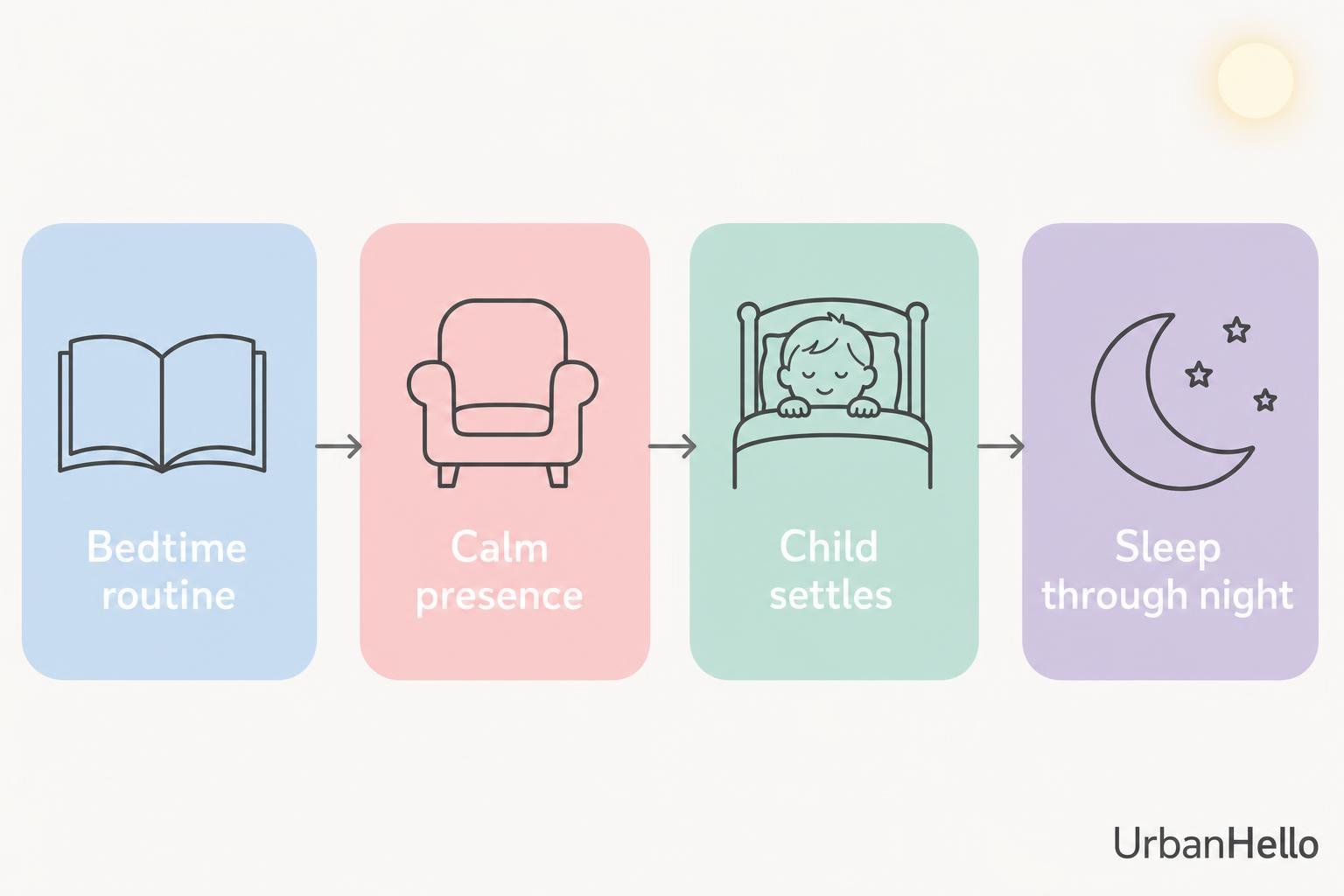
Gradual methods with parent presence
Among the available sleep training methods, gradual approaches allow you to remain present while slowly reducing your involvement. Each one helps a child learn to fall asleep independently over several nights.
- Chair method With the chair method, you sit near your toddler's bed during the first nights, then move the chair a few feet closer to the door every two to three nights. Eventually, you sit outside the room before withdrawing completely. This approach can take one to two weeks.
- Fading Fading gradually reduces parental support, such as patting, rocking, or time spent in the room. Night by night, these actions become shorter until the toddler can fall asleep without assistance. Progress is slow, but tears are often minimal.
- Excuse Me method This technique suits many children around age 3. After completing the routine and tucking the toddler in, you briefly leave with a simple excuse, return after a few seconds, and praise the child for staying in bed. The time away gradually increases across successive nights.
A special-pass system can complement gradual techniques when toddlers repeatedly call you back. Offer a small number of physical passes that can be exchanged for one parent visit, then calmly praise any unused passes in the morning. This gives your child both agency and a clear boundary, reducing the power struggle that makes repeated calls exhausting. If one caregiver suddenly changes the routine, the toddler may test boundaries again the following night.
Timed checks and clear boundaries
Families seeking a more structured plan may prefer timed check-ins or firmer extinction techniques. Results are often visible within three to four nights, although initial protest can be stronger. Timed check-ins and extinction demand a firm stance you can maintain from the first evening.
- Ferber method The Ferber approach places the toddler in bed drowsy but awake, followed by progressively longer waiting intervals before brief, calm check-ins. A common first-night sequence is 3, 5, and 10 minutes, with longer gaps on later nights.
- Longer and Longer Similar to Ferber but adapted for toddlers, this method uses intervals of 3, then 5, then 10, then 15 minutes. Sleep typically improves noticeably by the third night, and many toddlers fall asleep quickly by the fourth.
- Full extinction This approach involves placing the child in bed, saying goodnight, and not returning until morning. Because one return can reinforce prolonged protest, a video monitor is strongly recommended so you can observe safety without entering the room.
Research by Gradisar et al. (2016) and Mindell et al. (2006) found that behavioral interventions improve sleep outcomes without measurable negative effects on cortisol levels, emotional development, or parent-child attachment. Price et al. (2012) found no differences in emotional or behavioral health through age six between children who had undergone sleep training and those who had not.
Adjust the plan when bedtime stalls
Bedtime fading can help when your toddler regularly resists sleep for a long period after being put to bed. Temporarily shift bedtime 30 to 60 minutes later than the target time, until your child falls asleep within approximately 15 minutes of being placed in bed. Then move the start time gradually earlier by 15 minutes every two to three days, until you reach the desired hour.
When sleep training your toddler stalls despite consistent effort, review three points: whether your child can fall asleep independently at the beginning of the night, whether naps and bedtime suit the current developmental stage, and whether every adult responds identically to protests and bedroom exits. A change introduced by another caregiver, grandparent, or out-of-routine night can undo several nights of progress. Keep a nightly record of times and behaviors; objective tracking makes patterns easier to identify.
Handle night waking and build independence
Even when settling at bedtime improves, night waking may continue for several weeks. Understanding the reasons and responding without undoing your progress is essential for helping your toddler achieve consolidated sleeping.
Respond consistently overnight
Around 40% of toddlers aged 2 to 3 wake during the night, and approximately 20% wake more than once. This is developmentally normal: sleep cycles are maturing and lengthen to approximately 70 to 90 minutes. Each partial arousal gives your child an opportunity to reconnect cycles or seek parental help. A calm, brief response at each waking encourages your child to reconnect sleep cycles without seeking parental help.
When your child calls out or leaves their room, respond as you did at bedtime: calmly, briefly, and with little stimulation. Lengthy conversations, extended cuddles, or allowing your toddler to stay in your bed, even once, can reinforce an association with nighttime attention. Return your child to their room with minimal interaction, use the planned words, and repeat the same sequence each time.
- Room conditions Verify that the environment at 3 a.m. matches bedtime: the same darkness, sound, and temperature prevent sensory changes from disrupting lighter sleep stages.
- Hunger and comfort Persistent early waking may reflect hunger after an insufficient evening meal or discomfort from a soaked pull-up.
- Parasomnias Nightmares, night terrors, and sleepwalking are common and temporary during rapid brain development at this age. Respond calmly, offer brief reassurance, and do not repeat the full bedtime routine.
- Caregiver alignment Both parents, or all adults sharing overnight responsibilities, should use the same response every time. One inconsistent interaction can significantly prolong the process.
If early waking persists without an environmental or nutritional explanation, review whether your toddler's overall sleep schedule allows enough sleep pressure to build during the day. A nap that ends too late, or a bedtime earlier than the child's biological rhythm supports, can cause natural early rising that no behavioral method will fully resolve.
Know when to seek support
If your child still needs prolonged parental presence to stay asleep after several consistent weeks with a structured approach, a qualified sleep consultant can help. An assessment reviews current sleep habits, the environment, nap timing, daytime rhythm, and family goals before proposing a personalized plan. This guidance is particularly useful for toddlers with complex temperaments, medical concerns, or families transitioning from co-sleeping. This research also notes gains in parental well-being, particularly when plans are adapted to each family's routines.
Support packages vary widely. Self-directed written plans with one follow-up email suit confident families; daily email check-ins across three to five nights provide accountability; unlimited overnight messaging offers real-time guidance; and in-home overnight support allows direct observation of your child's cues. Families using responsive in-home support often report meaningful improvement within three to five nights, compared with slower progress when using a written plan alone. Your budget, confidence, and need for support should guide the choice.
Whatever format you choose, a comprehensive sleep plan should include an age-appropriate daily schedule with defined nap timing, wake windows, and bedtime; a behavioral technique suited to your child's temperament and your family's comfort; and guidance for challenges such as bedtime stalling, repeated bedroom exits, or very early rising. Expect setbacks, and apply the same calm response each time to help the plan take hold.
Choose REMI for lasting sleep support
REMI brings together practical tools for building and sustaining healthy sleep for your toddler in one companion. Its Wi-Fi baby monitor lets you listen from anywhere, speak through the two-way walkie-talkie feature, and receive noise notifications on your smartphone. The monitor's two-way audio lets you respond to sounds without entering the room, reducing nighttime stimulation. The expressive sleeping face on REMI's display provides a reassuring, consistent signal that your toddler can understand independently, making it a sleep companion rather than simply a device.
REMI's longevity distinguishes it from a single-function clock or monitor. Alongside the OK-to-wake alarm and nightlight, it offers built-in sleep tracking, a story and music player with USB upload capability, a Bluetooth speaker, and a classic alarm clock. These features grow with your child from birth through age 10 and beyond. If you want a trusted companion that helps your toddler fall asleep independently from the first night and remains useful through childhood, discover REMI and bring it home today.
Frequently asked questions
Is it too late to sleep train a 2- or 3-year-old toddler?
It is not too late. Toddler sleep training at ages 2 and 3 is entirely possible, although it differs from approaches used with infants. At this stage, children understand language, test boundaries, and may experience stronger separation anxiety.
A suitable plan addresses bedtime stalling, repeated exits from the bedroom, and curtain calls. When caregivers apply the same method consistently, many families notice meaningful improvement within one to two weeks. Starting later means adapting the method of sleep training, not abandoning the goal.
What is the gentlest method of sleep training for a toddler?
The gentlest approaches maintain some parental presence while reducing it gradually. With the chair method, a parent initially sits near the bed, then moves closer to the door every few nights.
A fading approach removes specific forms of help, such as rocking, patting, or lying beside the child, step by step. The Excuse Me method can suit 3-year-olds: a parent briefly leaves with a simple explanation, returns with praise, and progressively extends the time away.
These techniques can limit distress, but they generally require one to two weeks before independent sleep is fully established. Choose one approach and apply it consistently.
At what age should a toddler start sleeping alone in their own bed?
There is no universal age, but many sleep specialists consider the period between 2 and 3 years a natural time for a toddler to begin sleeping alone in their own bed. At this stage, children can understand simple explanations, follow visual cues such as an OK-to-wake clock like REMI, and develop self-soothing skills.
The transition is often easier when your toddler participates in small decisions, such as choosing bedding or a comfort object. Keep the boundaries around sleeping in their own bed calm and consistent from the first night.
Share this article:





Similar posts

Best baby monitor with app: Nanit and smart baby monitor picks
Find the best baby monitor with app for your family. Compare the Nanit smart baby monitor, top features, privacy, pricing, and which baby monitor suits you best.
How to choose an audio baby monitor: the ultimate guide
Ready to choose your baby's monitor? Our guide covers audio baby monitor features, safety, range & budget tips to find the perfect monitor for your baby.