Find a baby sleep trainer for your infant or toddler


Whether you are navigating endless night wakings or trying to establish a reliable bedtime rhythm, professional support and suitable tools can make a meaningful difference. This article explains how to choose a sleep trainer, which methods are available, what packages usually include, and how a smart device such as REMI can complement an approach from the newborn stage through age 10.
Choosing a sleep trainer for your family
Choosing the right support for your child’s sleep begins with understanding what a qualified professional evaluates. Each family has different needs, and a consultant who takes time to understand your child’s habits, your household rhythm, and your comfort level can offer more relevant guidance than a generic programme.

When expert support helps
A professional sleep trainer can help when you have adjusted the bedtime routine, followed conflicting advice, and still face persistent night waking, short naps, or early rising. A skilled consultant assesses the sleep environment, daytime rhythm, nap schedule, and family dynamics before recommending a plan. Research consistently shows that tailored behavioural interventions improve infant sleep outcomes.
- Persistent night waking: When a child wakes repeatedly despite consistent efforts, a trainer can help identify possible causes and establish a structured response.
- Short or inconsistent naps: Brief or unpredictable naps can disrupt daytime development. A consultant reviews nap timing in relation to wake windows and the wider daily rhythm.
- Bedtime resistance: Prolonged settling, frequent requests, and repeated curtain calls can be addressed through a graduated, family-friendly method.
- Early-morning rising: Waking well before the household is ready is a distinct challenge that may respond to schedule adjustments and visual cues from tools such as an OK-to-wake clock.
A non-judgmental first consultation gives you space to explain what you have tried, including the advice you have received, without feeling criticised. A qualified coach listens before creating a plan that reflects your parenting philosophy, your child’s developmental stage, and your practical constraints.
In-home and virtual training options
When parents search for a sleep trainer near them, they may find limited local availability, particularly in smaller cities or rural areas. Virtual consulting therefore provides a widely used alternative. Remote support follows the same structured assessment process as in-person work through calls, emails, and text messages, and many consultants support families across the United States and internationally.
- In-home guidance: A consultant observes a baby’s cues in real time and helps parents interpret signals during each phase of the night.
- Virtual coaching: Calls, texts, or emails provide flexible support with the same individualised approach, regardless of location.
- Hybrid packages: Some providers combine a remote assessment and written plan with one or more in-person evenings for first-night implementation.
Whether support takes place at home or online, ongoing follow-up matters more than receiving a document and being left alone. Teething, travel, and developmental leaps can disrupt progress, so a provider who remains available throughout the process can better support both children and parents.
Questions to ask a trainer
Before choosing a package, ask questions that clarify the consultant’s philosophy, experience, and methods. Providers differ in the age groups they serve, the techniques they use, and the follow-up included at each level of support. Clear answers help prevent mismatched expectations.
- Age-range experience: Confirm that the consultant has experience with your child’s developmental stage. Newborn programmes differ substantially from toddler behaviour work.
- Methods used: Ask which training approaches they use, whether gentle or gradual alternatives are available, and how they choose a method for a particular child.
- Follow-up structure: Clarify how many days of check-ins are included, whether overnight messaging is available, and what happens if progress stalls after the initial plan.
It is also reasonable to ask about the consultant’s position on crying. Sleep training does not always mean extended distress, and several responsive methods aim to limit tears while building independent sleep skills. Understanding the range of approaches, from the Ferber method’s timed check-ins to the gentler Fading approach, helps you choose support you can apply consistently.
For families who want visual support between sessions, the REMI ok-to-wake sleep trainer clock reinforces the distinction between day and night established by your consultant. It helps children understand boundaries without repeated verbal reminders and complements a professional plan from birth to ten years.
Baby and toddler sleep training by age
Children’s sleep needs change considerably from the newborn stage through toddlerhood. The support suitable for a three-month-old differs from what may help a two-year-old, so parents need realistic expectations and guidance that matches their child’s development.
When babies are ready for training
Most professionals do not recommend calling on a sleep trainer before a baby is at least four months old. At this stage, infants begin consolidating their sleep cycles and developing the neurological capacity to settle more independently.
Many consultants consider six months an appropriate starting point because most babies no longer have a physiological need for night feeds. Some families begin at four months, while others wait until nine months, depending on the infant’s development and their own readiness.
- Four to six months The nervous system has matured enough for babies to practise independent sleep skills, making this period suitable for gradual techniques.
- Six months Often regarded as an optimal point: night feeds are typically no longer physiologically necessary, and sleep cycles tend to become more predictable.
- Seven to nine months Families who are not ready at six months can still establish a strong foundation during this period, although separation anxiety may influence the chosen method.
A useful sign of readiness is when a baby can fall asleep at bedtime without prolonged assistance. This suggests that self-settling is already emerging, allowing a structured plan to build on that ability. A qualified consultant should also assess these cues before recommending a behavioural approach.
Newborn sleep shaping before four months
Before formal training is developmentally appropriate, newborn programmes focus on sleep shaping. The aim is to establish safe, predictable patterns and positive associations without expecting the infant to settle independently through a behavioural method.
Parents searching for a baby sleep trainer near me, one who works with very young babies, should look for newborn-focused support rather than standard sleep-training packages. During the first four months, sleep shaping centres on a consistent pre-sleep sequence, sensitive responses to hunger and discomfort, and a gradual distinction between day and night through light exposure and activity.
These early foundations can make later formal training easier to introduce and maintain. A newborn consultant therefore acts as an educator as much as a strategist. From birth, REMI can be used as an infant sleep training methods and their effects companion: its WiFi-connected baby monitor, adjustable nightlight, and audio features can support a calming sleep environment before any formal programme begins.
Its visual cues become more meaningful as the child grows, allowing the device to remain useful beyond the newborn stage and through age ten.
Toddler wake-up and bedtime challenges
Toddler sleep brings different challenges from infant sleep training. Bedtime stalling, nap resistance, repeated curtain calls, and very early morning rising commonly affect children aged two to five.
The REMI BLUE model is designed for this age group. Its expressive sleeping or awake face helps children understand whether it is time to rest or wake, reducing conflict at both ends of the night without requiring constant parental intervention.
Sleep training methods and costs
Many parents assume that improving a child’s sleep always means leaving them to cry without help. That is not the case. Available methods range from approaches with limited parental intervention to gradual techniques that keep a parent close throughout bedtime and the night. Understanding these options helps you assess a consultant’s recommendations and choose a plan you can apply consistently with your child.
Responsive and gradual training methods
When considering the cost of a sleep trainer for a baby, remember that the price usually reflects more than the method. Personalisation, follow-up, and whether a consultant provides support remotely or at home also influence the fee. Basic packages may include a written plan and one follow-up email, whereas overnight in-home assistance requires the greatest investment.
- Ferber method This graduated extinction method uses timed check-ins, with progressively longer intervals until the child settles independently. It is effective and widely researched.
- Chair method A parent or consultant stays in the room at bedtime, then gradually moves farther from the cot over successive nights until the child no longer needs close physical presence.
- Fading approach Also known as camping out, this method keeps a parent near the child while slowly reducing that presence over up to two weeks. It is often considered one of the gentler options.
- No Tears method This approach relies on a predictable pre-sleep routine and prompt soothing. Progress may take longer than with graduated methods, but distress is kept to a minimum for both child and parent.
With the Pick Up/Put Down technique, parents lift a crying baby to provide comfort and then return them to bed drowsy but awake. It is particularly suited to babies between four and eight months of age. A skilled trainer can adapt any approach to the family’s pace, the child’s temperament, and the parents’ ability to remain consistent. No single method suits every family.
What affects a support plan's cost
The cost of professional sleep support depends on the child’s age, the complexity of the situation, and the format and duration of the consultant’s involvement. Virtual services generally cost less than in-home care. A basic plan without night-time contact is also less expensive than a premium package with around-the-clock messaging.
- Format of delivery In-home support usually costs more than virtual coaching because it includes the consultant’s physical presence, travel, and real-time responsiveness during the night.
- Follow-up duration Plans with three or five days of consecutive email check-ins, or unlimited overnight text messaging, cost more than a single-plan package with one follow-up contact.
- Age and complexity Toddler cases involving layered habits or twins require more customisation and therefore generally represent a higher investment than a straightforward infant programme.
- First-night support Packages that include a 45-minute pre-implementation call and active guidance at bedtime on night one form the highest-touch and highest-cost tier.
Families seeking consistent, evidence-informed support without the full expense of an ongoing consultant relationship may also consider the REMI smart sleep trainer. It creates a structured, trackable sleep environment that can reinforce a professional’s method through a one-time purchase, with no recurring fees.
| Package type | Typical inclusions | Support level |
| Base sleep plan | Written schedule, method, one follow-up email | Low |
| Plan + daily check-ins (3 days) | Base plan plus three consecutive days of email support | Moderate |
| Plan + extended check-ins (5 days) | Base plan plus five days of email check-ins | Moderate–high |
| Bedtime support package | 45-minute call, first-night support, five days of email | High |
| Overnight support | 45-minute call, five days of unlimited day and night messaging, nap and bedtime guidance | Highest |
What research says about training
Research on behavioural sleep interventions is reassuring for parents worried about lasting effects. A randomised controlled trial by Gradisar et al. (2016) compared graduated extinction and bedtime fading with a control group. Sleep-trained infants fell asleep faster and woke less often during the night. At the twelve-month follow-up, researchers found no significant differences in cortisol levels, emotional or behavioural development, or parent-child attachment.
A meta-analysis by Mindell et al. (2006), which reviewed 52 independent studies, concluded that behavioural sleep interventions generally improve infant sleep and found no evidence of harm associated with their use. The evidence covered several methods, including graduated extinction, bedtime fading, and scheduled awakenings.
Price et al. (2012) followed children until age six and found no significant differences in emotional or behavioural health, stress responses, or parent-child relationship quality compared with children who had not undergone formal training. Together, these findings support informed decisions about professional sleep guidance for an infant or toddler.
Recommended products
What a sleep support plan includes
Understanding what a professional sleep plan contains, beyond the method itself, helps families compare packages and set realistic expectations. Follow-up support varies considerably between providers and package levels.

From assessment to daily plan
A comprehensive plan begins with an assessment of the child's current situation: existing habits, the sleep environment, nap timing, daytime rhythm, night waking patterns, and the family's goals. This evaluation informs the written plan, the daily schedule, the chosen method, the age-appropriate advice, and the training materials, making the guidance specific rather than template-based. During the initial consultation, the consultant also identifies the level of support the family is likely to need.
- Daily schedule A structured outline of nap timing, wake windows, bedtime, and expected overnight behaviour, adapted to the child's age and developmental capacity.
- Chosen method The behavioural technique selected according to the child's temperament, the parents'comfort level, and the pattern of sleep difficulties being addressed.
- Age-appropriate advice Practical recommendations about the sleep environment, pre-sleep routine, feeding, and daytime activity, based on the child's developmental stage.
Some providers add a training video or audio guidance to the written plan, giving parents a practical reference during the first nights, when uncertainty is often greatest.
Levels of night support
Some parents can implement a written plan independently after a preparatory call, while others benefit from text messaging during the night or an in-home professional present from the first bedtime.
- Self-directed implementation A detailed written plan with one follow-up email can suit families who feel confident, remain consistent, and are addressing a straightforward sleep challenge.
- Daily check-in packages Three or five consecutive days of email support allow a consultant to monitor progress, adjust the plan, and reassure parents through the most difficult initial nights.
- Overnight text support Unlimited daytime and overnight messaging gives parents immediate access to guidance during the night, helping reduce anxiety and maintain consistent responses.
The highest-touch option, in-home overnight support, places a trained professional in the family's home to observe the baby's cues and guide parental decisions in real time. Research suggests that this responsiveness can reduce confusion for both child and parent, producing quicker results with fewer tears than self-directed implementation. Families using this model often report significant improvement within three to five nights.
Support beyond the first week
A reliable consultant remains available after the initial plan has been delivered. Sleep routines change with teething, developmental leaps, illness, travel, and the eventual dropping of naps. Continued guidance protects the progress already made and may prevent the need to restart a complete programme. Twin-specific plans with extended bedtime and overnight support are also available for families managing two children at once.
For families seeking continuous, low-effort monitoring between consultant check-ins, a smart device such as the REMI smart sleep trainer provides nightly tracking through its Night Score feature. This data can help parents notice emerging disruptions before they become established habits, complementing professional support as the child develops from birth to age ten.
A smart sleep trainer for children
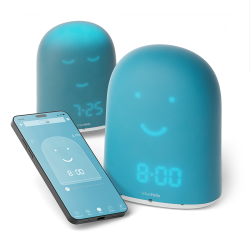
Professional consulting addresses the behavioural and relational dimensions of children’s sleep, while a consistent physical environment also helps build durable habits. REMI is a French-designed smart sleep trainer combining an OK-to-wake clock, baby monitor, nightlight, audio system, and sleep tracker in one connected device. It adapts from birth through age ten and reinforces the routines established with a professional.
Visual cues for sleep and wake times
REMI uses a simple visual signal: an expressive face shows your child whether it is time to sleep or wake. When the sleeping face appears, children learn to remain quietly in bed; when the awake face appears, they know they may get up. Over time, this distinction between night and day supports greater independence without repeated reminders.
Through the connected REMI app, available for Android and iOS, parents can set separate sleep and wake schedules for every day of the week. The app also adjusts the nightlight brightness, selects sounds, and customises REMI’s facial expressions. Families seeking local support may encounter a Fort Lauderdale sleep trainer, Cleveland sleep trainer resources, a Lexington sleep trainer programme, Indianapolis sleep trainer options, Greensboro sleep trainer support, a Milwaukee sleep trainer service, a Pittsburgh sleep trainer provider, a Philadelphia sleep trainer consultant, Louisville sleep trainer offerings, Henderson sleep trainer guidance, a Columbus sleep trainer network, a Memphis sleep trainer programme, and a Chesapeake sleep trainer service. Availability varies by location, whereas REMI offers a consistent complement at home.
- OK-to-wake clock Sleeping and awake facial expressions communicate bedtime boundaries intuitively, without language or repeated parental intervention.
- Night Score tracking Each morning, the app presents a Night Score based on the previous night’s patterns, giving parents useful information for refining the child’s routine.
- Customisable schedule Sleep and wake times can be set independently for each day, accommodating nursery days, weekends, and seasonal changes without manual adjustments.
Documented results indicate that parents using REMI gain an average of 45 additional minutes of sleep per night, a meaningful improvement for families managing ongoing sleep deprivation alongside work and daily responsibilities. The WiFi connection can be scheduled to switch off at night for families seeking to reduce exposure to radio waves. REMI’s core functions, including the nightlight, music, and OK-to-wake face, continue operating without interruption.
Night routines managed in the app
REMI’s connected app simplifies evening preparation. Parents can upload MP3 files, lullabies, white noise, or bedtime stories via USB, or access exclusive content through the REMI Store. The adjustable nightlight ranges from a soft shimmer to a full glow and can be dimmed remotely once the child is asleep, avoiding a return to the room that could disturb settled sleep.
The built-in walkie-talkie and WiFi baby monitor let parents listen and respond remotely. This can offer reassurance during a night waking or remind a child who wakes too early that the awake face has not appeared yet. A temperature sensor provides additional environmental awareness, helping parents monitor the room throughout the night.
Buy REMI for bedtime support
REMI is currently on sale at urbanhello.com, with an exclusive extended warranty of three years instead of two and a 60-day money-back guarantee. Regular software updates help its features evolve with your child’s changing needs, from the first weeks of life through age ten.
Whether you work with a professional consultant or manage your child’s sleep independently, REMI provides structure, tracking, and a supportive sensory environment that make healthy habits easier to establish and maintain night after night.
Frequently Asked Questions
A sleep consultant first assesses your child's current habits, sleep environment, nap schedule, and daytime rhythm before recommending a method. They then create a personalised plan with a daily schedule, a suitable training technique, and age-appropriate advice. Ongoing support may include emails, calls, or overnight messages. This helps your child settle independently, with strategies adapted to your parenting style and household routine.
Most professionals consider four to six months the earliest suitable window for formal behavioural sleep training. Six months is often cited as an ideal starting point because most babies no longer have a physiological need to feed during the night. Some infants may be ready at four months, while others benefit from waiting until nine months, particularly when separation anxiety is involved. Before four months, focus on sleep shaping, positive associations, and predictable routines rather than a formal training method.
For many families, a smart sleep trainer such as REMI provides the visual structure, consistent scheduling, and nightly tracking needed to establish healthy routines without professional support. REMI's OK-to-wake facial cues, Night Score monitoring, and customisable app-managed schedules address common challenges such as early waking, bedtime resistance, and inconsistent night behaviour in a self-directed, evidence-consistent way. When several difficulties overlap, professional consulting and REMI can work well together, with the device reinforcing the trainer's plan every night between check-ins.
Share this article: