
Toddler bedtime routine tips: steps, schedule and REMI


Calm toddler evenings rarely depend on one trick. They come from a sequence your child can predict, a bedtime that matches how much sleep they need, and steady answers when they push back. These toddler bedtime routine tips walk you through each step of the evening. They also show you how to choose the right hour, respond to stalling and night waking, and where we designed REMI to help.
Build a calming toddler bedtime routine
A bedtime routine for toddlers is a short series of steps repeated in the same order each evening. The sequence marks the move from daytime activity to sleep, and the familiar steps help your child understand what comes next. To create a bedtime routine that holds up over time, plan a gradual slowdown first, then a fixed ending.
Start winding down before bed
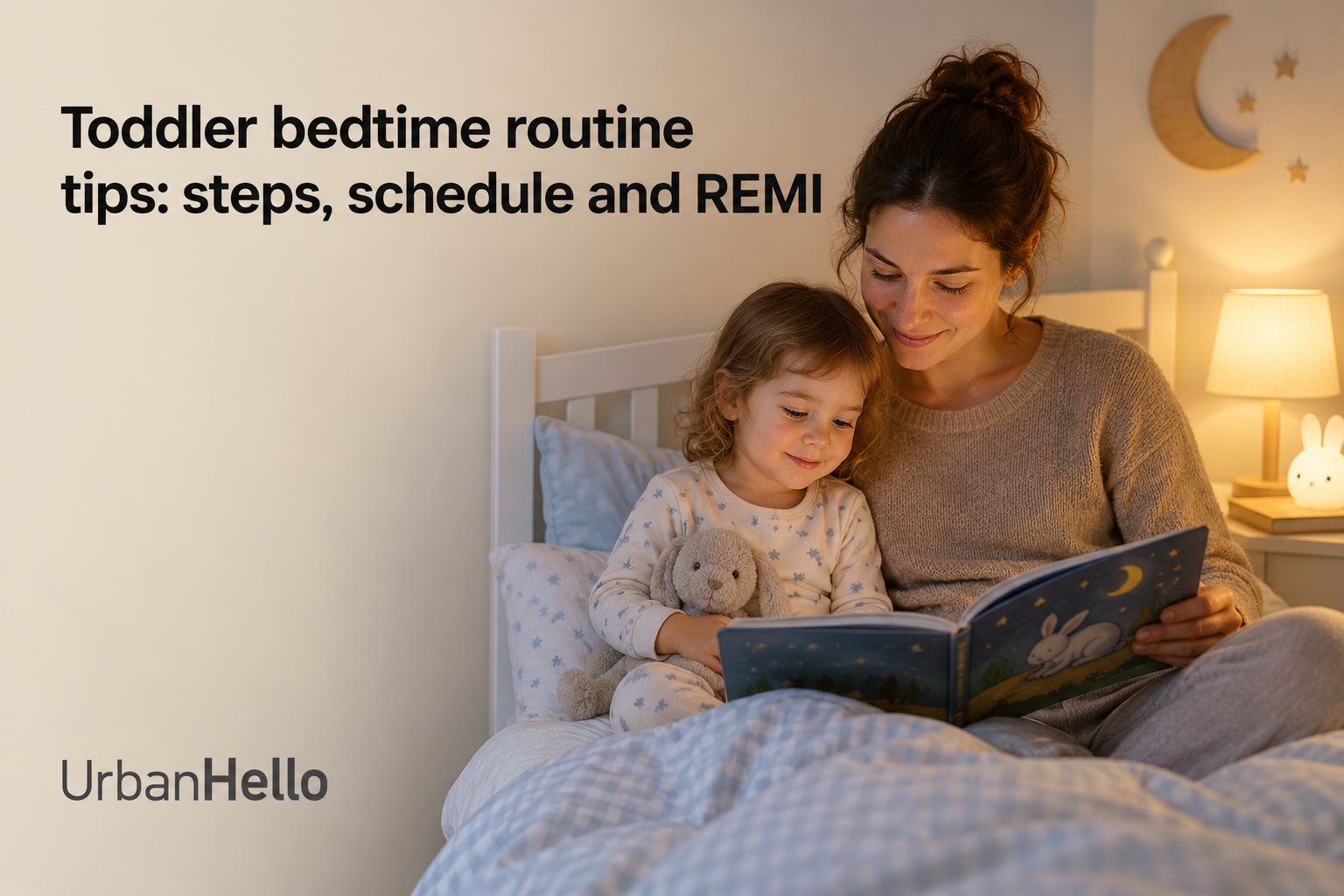
A practical wind-down can begin 30–45 minutes before bed, and you can adjust that length to suit your child. Toys go away, screen time ends and lights are dimmed. Calming activities such as coloring, puzzles, reading or gentle play then replace stimulating content and energetic games.
A warm bath or wash can come before pajamas, but it is optional. Some toddlers come out of the tub more lively than they went in. If that is the case for yours, a soothing bedtime routine may work better with the bath earlier in the evening or without it.
Follow the same final steps
The American Academy of Pediatrics recommends a simple sequence called Brush, Book, Bed: brush teeth, read, then go to bed at a regular bedtime. Each step can follow a few practical guidelines.
- Brushing teeth: the AAP advises a smear of fluoride toothpaste before age 3 and a pea-sized amount at ages 3–6, with an adult helping and supervising.
- Book: 1 or 2 favorite books give you quiet time together, and the AAP notes that reading aloud supports language and social-emotional development.
- Goodnight: a familiar phrase or hug, followed by the same lights-out expectation each night, signals that the sequence is over.
A book is not the only way to settle a child. A quiet song, a short conversation or a cuddle can accompany the story or take its place when it helps your toddler relax.
Make the routine easy to repeat
A toddler bedtime routine chart uses pictures to show the order of the steps to a child who cannot read yet. Let your child choose the pictures or move a marker as each step is done. Limited choices, such as which pajamas to wear, give them a role while keeping the sequence bounded.
Some nights will be harder than others. On those evenings, a shorter version can keep the essentials: pajamas, toothbrushing and one brief book. A successful bedtime routine is one you can actually complete most nights, not the longest one.
This kind of consistency appears to pay off. In a three-week randomized study of 405 mother-child pairs, including children ages 18–36 months, a consistent bedtime routine improved young children's sleep as reported by mothers, with shorter time to fall asleep and less night waking. The result was not guaranteed for every child, but it supports establishing a bedtime routine as one of the foundations of healthy sleep habits.
Choose a bedtime that fits your toddler
The right sequence can still struggle if it starts at the wrong hour. The ideal time depends on your child's own rhythm rather than a universal rule. Setting a toddler sleep schedule means looking at the whole day: when they wake, how long they nap, and when they actually start to get drowsy.

Work backward from sleep and wake times
No single clock time suits every toddler, not even every 2-year-old. Four elements help you place toddler bedtime on the evening clock.
- Morning wake time: the hour your child usually gets up anchors the rest of the day.
- Total sleep: 10.5 hours of night sleep plus a 1.5-hour nap gives 12 hours, within the recommended range for ages 1–2.
- Naps: around age 2, many toddlers take 1 afternoon nap lasting about 1–3 hours, though needs vary.
- Sleepiness: the moment your child genuinely becomes drowsy shows when they are ready.
Counting back from wake time by the night sleep your toddler needs gives a first estimate. You can then refine it by watching how quickly your toddler falls asleep once the lights go out.
Check whether naps affect bedtime
A long or late nap may leave your toddler less sleepy in the evening, so check nap timing before treating resistance as purely behavioral. Some children stop napping during the preschool years while others still need daytime sleep, and bedtime resistance alone does not show that a nap should go. When naps become inconsistent, a quiet rest period can stay in the day, and an earlier bedtime may suit a no-nap day.
Adjust a bedtime that misses the mark
An overtired child may look hyperactive, silly or cranky rather than calm and drowsy. Other clues that bedtime is too late include difficulty waking in the morning, daytime moodiness and dozing off in the car or stroller. A tired toddler showing these signs may benefit from an earlier start to the routine.
The opposite problem looks different. If your child regularly lies awake without seeming tired, you can shift the routine 15 minutes later over 2–3 nights. For children who consistently fall asleep well after their scheduled bedtime, Mayo Clinic describes bedtime fading: setting bedtime temporarily closer to the usual sleep time, keeping morning waking consistent, then moving bedtime earlier gradually. This guidance mainly addresses preschoolers ages 3–5.
Recommended products
Handle bedtime battles and night waking
Even with a well-timed sequence, most families meet sleep challenges at some point. A toddler fighting bedtime is often testing limits, but they may also be expressing a real need. Your responses work best when they are calm, brief and the same from one night to the next.
Set limits on repeated requests
Requests for another drink, another story or another hug often follow lights out. Meeting predictable needs beforehand and announcing a finite sequence, such as 2 books and 1 hug, can reduce them.
Once the agreed final step is done, you can answer nonessential requests briefly and calmly. That limit never prevents you from checking for genuine thirst, pain, fear or illness.
A meltdown does not have to break the boundary. You can acknowledge your child's feelings and offer brief comfort while still keeping bedtime in place, without adding another lengthy activity.
Respond calmly when your toddler needs you
Some toddlers become afraid of the dark. Reassurance and a dim nightlight may help, while turning on bright room lights or repeatedly treating the room as dangerous can reinforce the worry. If your child cries for you, check practical needs, offer brief reassurance and follow through on any check-in you promised.
Nightmares can also wake a toddler. After a bad dream, your child may need comfort and reassurance before returning to sleep.
Keep responses predictable through disruptions
Some parents want their child to fall asleep with less help over time. Brief check-ins or gradually moving your chair farther from the bed can ease that transition; Mayo Clinic presents these approaches mainly for preschoolers. A child who repeatedly leaves a toddler bed can be returned calmly with minimal conversation, provided the room is safe for a mobile child.
Illness, teething, travel or a missed nap may call for a shorter, more flexible evening. When several caregivers share bedtime, agreeing on the same core sequence and limits keeps the predictability intact. Return to the familiar routine once things settle.
Use REMI to support the bedtime routine
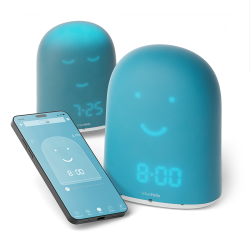
We designed REMI to fit into each stage of the evening described above, from wind-down to morning. A single device in the toddler bedroom can provide gentle light, bedtime audio, a visual sleep-and-wake cue and remote listening. Each feature remains a support for the routine, not a substitute for it.
Set gentle light and bedtime audio
The REMI smart sleep trainer's nightlight can be adjusted in brightness from the app, set manually or scheduled; its automatic behavior depends on ambient light. A child comfortable in darkness does not need a nightlight at all. A few settings help the light and audio serve the routine.
- Low brightness: keep the light dim and switch off unnecessary room lighting.
- Placement: position REMI so the light does not shine directly into your child's eyes.
- Lullabies: built-in tunes can accompany the last minutes of wind-down.
- Play button lock: disable the story keypad if your child keeps restarting audio after the agreed final story.
Light settings deserve attention. A 2026 laboratory study of 25 nightlights found that light exposure varied substantially across nightlights and their settings, without showing that every nightlight harms sleep.
Audio can extend the shared reading moment. REMI can tell a bedtime story chosen from children's tales available in the REMI Store, and REMI's story box and bedtime tales include calming stories for winding down.
Teach the sleeping and awake faces
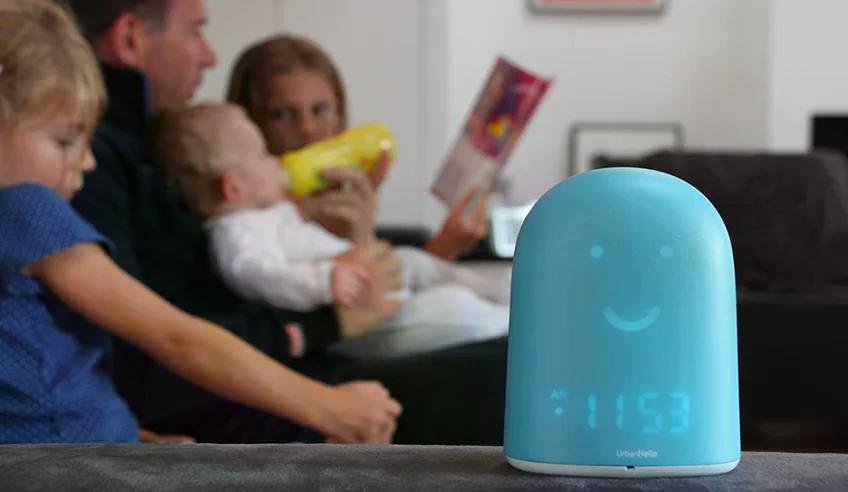
REMI's scheduled sleeping face tells your toddler it is still time to rest, and its awake face shows when they may get up. Your child does not need to read numbers, which makes REMI's OK-to-wake clock readable from a young age. Explain the 2 faces during the day, practice the rule through pretend play and praise progress; a very young toddler may not follow the cue reliably yet.
Set the morning face to a realistic wake time, and schedules can differ by day of the week. If your child wakes earlier, genuine needs for comfort, toileting or safety still come first. A clock cannot make an underslept or ill child sleepy.
Use connected features as your child grows
According to Urban Hello, REMI's Night Tracking records room noise, ambient temperature and light, then estimates bedtime and wake time from noise patterns. The Night Score shown each morning helps you adjust the routine, but it is not a clinical measure of sleep quality and may count a quiet awake child as asleep. Persistent sleep concerns belong with your pediatrician.
The Wi-Fi baby monitor lets you listen from anywhere, receive noise alerts and talk to your child through walkie-talkie mode, for instance to remind them it is still sleep time. Setup requires Wi-Fi, remote functions depend on connectivity, and REMI stays plugged in. Urban Hello offers REMI as a companion from birth to about age 10, combining baby monitor, OK-to-wake clock, sleep tracking, story box, Bluetooth speaker and alarm clock. To give your toddler a trusted companion that watches over their sleep environment for years, you can order REMI directly from Urban Hello.
Frequently Asked Questions
The American Academy of Pediatrics gives 68–72°F as general bedroom temperature guidance for infants and children. It is not an exact setting every room must maintain. The aim is a comfortably cool room rather than a hot or stuffy one, with dimmed lights and lower household noise as bedtime approaches.
Keep cords, charging cables and plug-in lights out of reach, and secure electronic devices so your child cannot pull them onto the bed. Keep objects with strings or ties away from the crib, and avoid large pillows or toys a toddler could use to climb out. Any comfort object should be bed-safe, without detachable buttons or other choking hazards.
Each has trade-offs. Printable charts are easy to customize but may need protection or replacement, while magnetic charts are reusable but small magnets can pose a choking hazard to younger siblings. Whichever you choose, placing it where a partner, grandparent or babysitter can see it helps everyone follow the same sequence.
Share this article:





Similar posts

How to help an anxious child sleep: calming bedtime tips
See how to help an anxious child sleep with a soothing routine, coping techniques, and REMI's nightlight and stories, plus when to seek professional help.
Sleep tracking app for kids: how REMI's sleep tracker works
See which features, accuracy limits and costs to check in a sleep tracking app, and how REMI's Night Score follows your child's nights.