Sleep tracking app for kids: how REMI's sleep tracker works


Choosing a sleep tracking app for your child starts with one question: what does the app actually measure? This guide explains how phones, wearables and bedside devices estimate sleep and what research says about their accuracy. It then covers the features and costs worth comparing, and how the sleep tracker in REMI, Urban Hello's sleep companion, follows your child's nights.
How does a sleep tracking app estimate sleep?
No consumer app watches sleep directly. Each one infers rest from a signal it can capture: sound, movement, heart rate or room conditions. The method behind a chart decides what its sleep analysis can tell you, so it helps to know which signal your chosen tool relies on before you trust its graphs.
What can a phone detect?
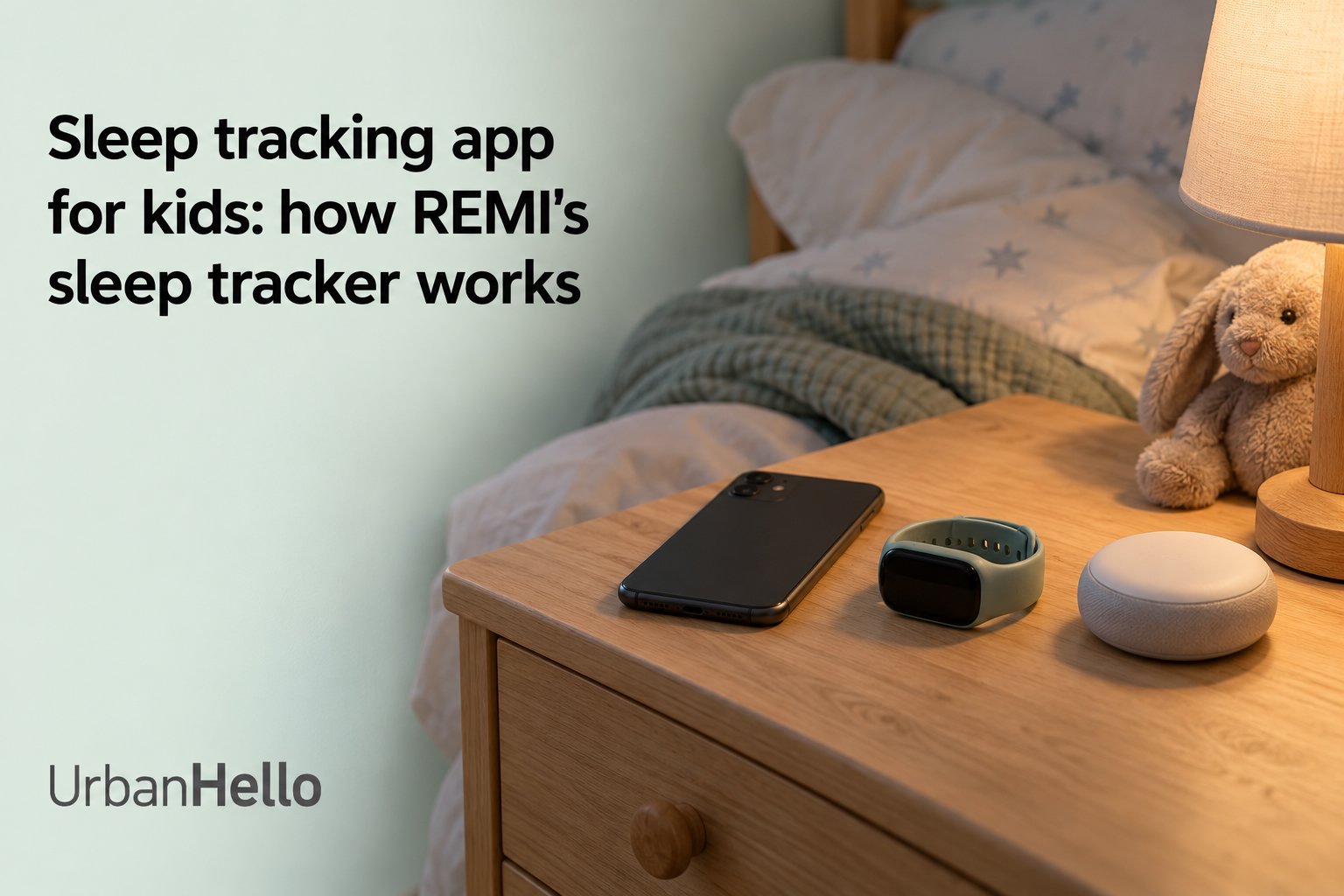
A smartphone placed in the bedroom uses its built-in sensors in three main ways. Each one captures a different part of the night and has its own blind spots.
- Sound detection: the microphone picks up snoring, coughing or talking, but audio alone does not identify a sleep stage.
- Movement analysis: the app reads stillness as sleep and movement as wakefulness.
- Sonar tracking: some compatible phones emit inaudible sound waves and read their reflections from breathing-related chest movement.
- Placement requirements: sonar works only when the phone sits close to chest height.
Movement-based logic has a clear weakness with children. A child can lie quietly while awake or toss while deeply asleep, and both situations lead to a wrong label. A recording of snoring can show that something happened, but it doesn't show which stage of sleep your child was in.
What do wearables measure?
A wearable worn on the wrist combines movement with heart rate and sometimes other biometric signals. From these inputs, it estimates sleep and wake periods and, on some models, sleep stages. Adding a second signal gives more context than motion alone, though the result is still an estimate.
With a child, the practical side matters as much as the sensors. The wearable needs to fit properly, have enough battery for the night and stay on until morning. A strap removed at midnight or a dead battery leaves gaps that no algorithm can fill.
Can an app detect a sleep cycle?
A bedside tracker on the nightstand takes another approach. It records room noise, light or temperature without your child wearing anything. These readings describe the bedroom, though, not your child's body. REMI belongs to this family: it watches the environment rather than the sleeper.
Clinical polysomnography, the sleep study done in a lab, records brain activity, eye movements, muscle activity, breathing and heart rate. These signals are what define each sleep cycle and its phases, such as REM sleep and deep sleep.
A consumer chart showing a neat sleep cycle across the night is therefore an inference drawn from more indirect signals. It can be a useful picture of the night, but it doesn't mean your child's physiological cycles were measured.
How accurate are children's sleep estimates?
Accuracy differs from one device to the next, and adults are tested far more often than children. Research comparing consumer tools with polysomnography gives an order of magnitude for these differences and shows why a single night's numbers should be read with care.
What do validation studies show?
A meta-analysis of 24 studies with 798 participants found that wrist-worn trackers differed from polysomnography by an average of −16.85 minutes for total sleep time. Sleep efficiency differed by −4.69 percentage points, and time to fall asleep by +2.57 minutes. Wake after sleep onset was off by +13.26 minutes. These are pooled averages, not an error margin for any one child or app.
Studies in younger users show gaps of their own. In a study of 58 healthy adolescents, wearables and research actigraphy differed from polysomnography by up to 47 minutes for total sleep time and 42 minutes for night wakefulness. Another study tested 17 children averaging 11 years old and 17 adolescents averaging 17.8 years old, and sensitivity varied across wrist devices. In a 2016 study of children and adolescents, one smartphone-based method underestimated night waking by an average of 63 minutes and overestimated total sleep by 106 minutes.
How should parents read sleep data?
The American Academy of Sleep Medicine recommends 12–16 hours per 24 hours, naps included, for infants aged 4–12 months. The range is 11–14 hours at 1–2 years and 10–13 hours at 3–5 years. School-age children aged 6–12 need 9–12 hours, and teenagers aged 13–18 need 8–10 hours. The Academy set no range below 4 months, because patterns vary widely and the evidence was insufficient.
With young children, add naps to the night before you compare an estimated sleep duration with these 24-hour ranges. Age-based sleep recommendations for children describe a whole day, and one night's result is not a diagnostic test.
Each sleep score relies on its own sensors, inputs, algorithm and scale, so the same number on two apps can describe very different nights. An app update can also change the estimate when your child's sleep hasn't changed. Bedtimes, wake-up times and patterns that repeat over several weeks tell you more about sleep quality than any one new figure.
When is an app not enough?
The American Academy of Sleep Medicine cautions against using consumer sleep technology to diagnose or treat sleep disorders without proper validation and clinical evaluation. No score can show that your child breathes normally or rule out a condition such as sleep apnea. Persistent difficulties, habitual loud snoring, breathing pauses or marked daytime sleepiness all call for pediatric advice.
The American Academy of Pediatrics states that consumer monitors have not been shown to reduce the risk of sudden infant death syndrome and cannot replace safe-sleep practices. On September 16, 2025, the FDA warned against unauthorized infant devices that claim to measure pulse, oxygen saturation, breathing rate or temperature. If your child needs medical monitoring, a healthcare professional can recommend an appropriately authorized device.
Which sleep app features matter for kids?
A sleep app designed for adults and one built around a child's day solve different problems. Parents usually want to understand naps, night wakings and the hour of the bedtime routine, not a detailed map of sleep stages. The features worth comparing follow from that need.
Which features fit a child's routine?
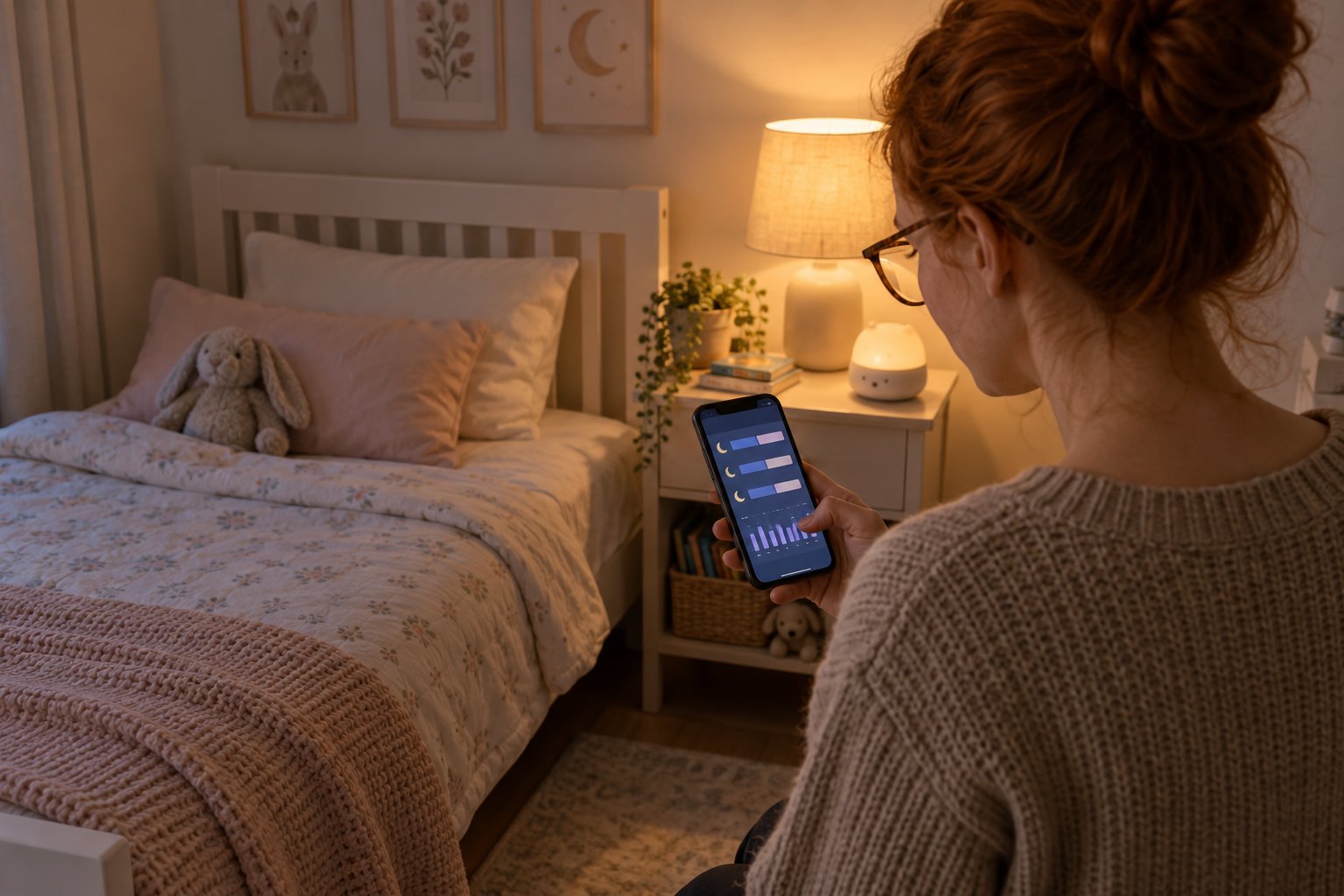
A child-focused log records bedtimes, naps, night wakings and wake-up times, and it can be useful without identifying sleep stages. A smart alarm that wakes an adult during light sleep answers a different question from when a baby napped or needed attention. Here are the other features to compare.
- Care records: feeding and diaper entries alongside the sleep notes.
- Profiles and history: one profile per child, with past nights easy to review.
- Predictions: suggested nap windows built from logged sleep habits.
- Caregiver access: whether a partner or babysitter can view or export the records.
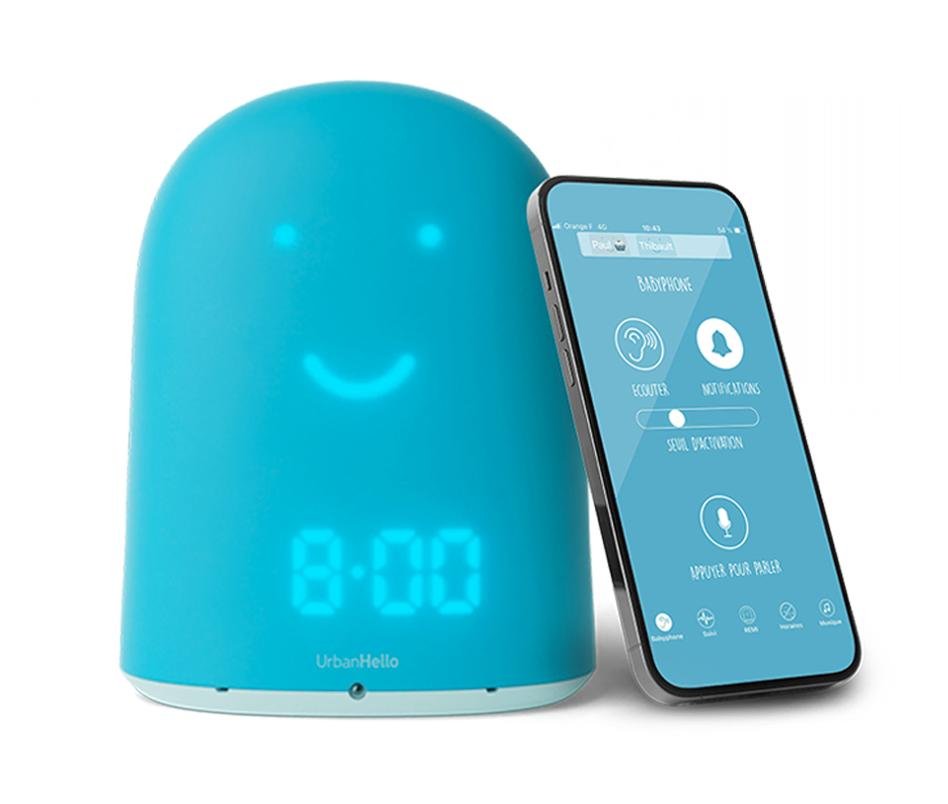
REMI combines its sleep tracker with a nightlight, an expressive clock face that shows when it's time to sleep or get up, a story player, a Bluetooth speaker, a walkie-talkie and a classic alarm clock. Its Wi-Fi baby monitor lets you listen and talk to your child from your phone, wherever you are. It also sends noise notifications, and you can set the sound threshold that triggers them. Urban Hello designs this companion for children from birth through age 10.
What should parents check about privacy?
Before you turn on overnight audio, check whether the app records or stores raw clips, processes sound on the device or on remote servers, how long it keeps recordings and how you can delete them. Microphone permissions should stay under your control. In a shared room, a sound may come from a sibling, a parent, a pet, a TV or a white-noise machine, not from your child. Caregiver access, remote-listening security, export options and whether former caregivers still have access also deserve a look.
What does free really cost?
A fair first-year comparison adds any required hardware to 12 months of required subscription fees, and then the optional features your family would actually use. A free download, a lasting free tier and a temporary trial are three different things. Some sleep tracking apps are free to start, so check which logs, history, reports, predictions and sounds still work when the trial ends.
REMI works with a dedicated bedside device rather than a phone-only download, so the hardware is the main cost. Urban Hello describes the mobile baby-monitor app as free. Core sleep tracking was not found to require a recurring subscription, while optional in-app content purchases are listed. The REMI Wi-Fi baby monitor uses this same app, and the REMI smart sleep trainer includes the device itself.
Recommended products
How does REMI's sleep tracker work?
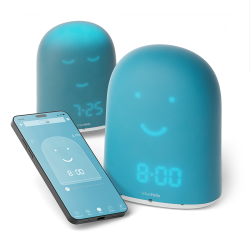
REMI doesn't rely on a wristband or on movement. Urban Hello explains that the device works out bedtime and wake-up times by analyzing noise in the bedroom. Each morning, the app shows a Night Score that compares those detected times with the schedule you planned.
How do parents set up tracking?
The REMI app is available on iOS and Android, so it suits Android and iPhone households alike. Setup takes three steps.
- Install and power: download the app, then plug REMI into a wall outlet next to the bed.
- Pair and connect: pair the device through Bluetooth from the app, then connect it to your home Wi-Fi.
- Finish setup: complete the remaining steps and set bedtime and wake-up times in the Schedules tab.
REMI has a microphone, an ambient-temperature sensor and an ambient-light sensor. The app shows room noise, temperature and light on an overnight timeline. If Wi-Fi drops, REMI stores its sleep data on the device and syncs it later. The remote baby monitor and walkie-talkie, however, need an internet connection.
How are bedtime and wake-up detected?
According to Urban Hello's Night Tracking FAQ, REMI records bedtime after 1 hour of silence. It records wake-up when noise follows that quiet period. When you program bedtime and wake-up faces in Schedules, REMI looks for these moments around the times you set.
Sound is a useful clue, though not a perfect one. A child lying awake in silence may be counted as asleep, and unrelated noise in the room can look like waking. For this reason, the timeline is best read alongside what you observed that night.
What does the Night Score mean?
The closer the detected times match your schedule, the higher the score. It reflects timing and sound against your planned routine. It doesn't measure REM or deep sleep, brain activity, heart rate or breathing.
Sometimes no score appears. This happens when the bedtime and wake-up faces aren't set in Schedules, when the noise record lacks quiet periods after bedtime and before waking, or when REMI can't identify both times.
The icon at the top right of the Tracking tab opens 60 days of night history, so you can follow how sleep patterns change over time. The guide to REMI night tracking and Night Score explains each of these cases in detail.
Why choose REMI to follow your child's nights?
REMI doesn't claim to map sleep stages. Instead, it gives you clear bedtimes, wake times and 60 days of history to help you adjust your child's routine. As a baby monitor, it lets you listen and talk to your child from anywhere and sends noise notifications. Its sleeping or awake face shows your child when to stay in bed, so REMI becomes a trusted companion that watches over every night.
REMI also grows with your child. Beyond the baby monitor and OK-to-wake clock, it adds sleep tracking, a walkie-talkie, a story box, a Bluetooth speaker and a classic alarm clock, which keeps it useful through age 10. To give your child this companion from the first nights onward, order REMI today.
Frequently Asked Questions
Some child-focused logs offer basic sleep and care recording for free, while predictions or extended insights require a paid tier. A free download, a lasting free tier and a temporary trial are not the same thing. Check the current app listing to see which logs, history, reports, predictions and sounds stay available without payment.
They are useful for following approximate bedtimes, wake times and trends, but their sleep-stage estimates are less reliable than a clinical sleep study. In a 2015 pediatric comparison, one older wrist device overestimated total sleep by 41 minutes in normal mode. In sensitive mode, it underestimated total sleep by 105 minutes. These findings don't describe current devices in general.
For a basic scheduling question, it can help. You can note lights-out, estimated sleep onset, final wake time, naps and noticeable awakenings, then decide whether automated tracking adds anything. A manual log, a microphone, a motion sensor and a bedside room monitor each capture something different, so their results shouldn't be treated as interchangeable measurements.
Share this article: