How long does 4-month sleep regression last?


This article explains its causes, typical duration, signs to watch for, and practical steps that can help your baby move through this developmental phase more smoothly. For an in-depth look at choosing an audio baby monitor during this period, a dedicated guide covers sound quality, connection types, and alert settings in detail.
How long does the 4-month sleep regression last?
The 4-month sleep regression is one of the most commonly discussed disruptions in infant sleep.

The usual 4-month timeline
Parents often ask how long the 4-month sleep regression lasts, and the honest answer is that it varies from one baby to the next. For most, the acute phase spans 2 to 6 weeks, with disruptions peaking in the first few weeks before gradually easing.
- Shortest cases A handful of babies show only a few days of frequent waking before sleep steadies again, often because they already have some capacity for independent settling.
- Typical duration Most families notice the sharpest disruption across 3 to 4 weeks, after which nighttime wake-ups gradually become less frequent and naps begin to lengthen again.
- Longer experiences When sleep-onset associations are strong, such as feeding or rocking to sleep, disruptions can persist beyond 6 weeks until the baby learns to settle independently.
- Premature babies For babies born early, timing is better assessed by adjusted age rather than chronological age, so regression signs may appear later than expected.
The sleep maturation driving this phase is permanent: babies do not return to newborn-style sleep afterward. Most babies achieve this gradually, often without formal intervention, particularly when routines are calm and consistent.
Why sleep changes feel sudden
Many parents wonder precisely when the 4-month sleep regression starts, and most find it appears somewhere between 3 and 4 months of age, sometimes catching them off guard after a relatively settled stretch. The shift can feel abrupt because the underlying neurological change happens over a short window, and a baby who was sleeping in longer stretches may suddenly begin rousing every one to two hours within just a few nights.
Around this same period, the circadian clock and melatonin production become more established, which is a positive development that gradually supports longer overnight sleep. The baby's growing awareness of the environment, however, means that each light-sleep arousal carries more potential for full waking. These two forces, maturing rhythms and heightened alertness, exist simultaneously, which is why the regression marks such a noticeable turning point in early infant sleep.
Why the 4-month sleep regression happens
Understanding the biological mechanism behind this disruption helps parents respond with realistic expectations. The 4-month sleep regression is not caused by anything parents did or failed to do. It reflects a predictable point in neurological development, as consistent in its arrival as first smiles or head control. Knowing its origin helps separate useful responses from unnecessary worry.

A permanent change in sleep cycles
What some dismiss as a 4-month sleep regression myth is, in fact, a well-documented and permanent biological shift: at around this age, babies stop cycling through sleep as newborns do and begin moving through stages of light sleep, deep sleep, and active sleep in a distinctly more adult-like pattern. This change is driven by neurological maturation, not by teething, illness, or parental behavior. Those factors can worsen disruption, but they are not the root cause. The sleep cycle itself is reorganizing at a structural level.
Newborns spend a large proportion of their rest in deep sleep, which is why they can be moved from arms to crib without stirring. After this developmental transition, babies spend more time in lighter stages of each sleep cycle and briefly arouse at the boundary between cycles. If a baby cannot settle back independently at that moment, a brief arousal becomes a full wake-up, producing the characteristic pattern of frequent night wakings that defines this phase.
Common signs parents may notice
When considering how long 4-month sleep regression lasts for naps, many parents find that daytime sleep shortens noticeably during the same period as nighttime disruption. A baby may wake after completing one sleep cycle, roughly 20 to 45 minutes, and be unable to bridge into the next without help. Recognizing the full picture of month sleep regression signs helps parents distinguish this phase from other causes of poor sleep.
- Frequent night wakings Waking every 1 to 2 hours overnight is the most recognizable sign, directly reflecting the baby's new cycle structure and difficulty resettling independently.
- Short naps Daytime sleep often caps at 20 to 45 minutes as babies rouse at the end of one cycle before learning to connect smoothly to the next.
- Increased fussiness Accumulated fatigue from fragmented sleep leads to more irritability during waking hours and a lower threshold for overstimulation before naps and at bedtime.
- Resistance to being put down Babies become more sensitive to environmental changes, making the transition from arms to crib more likely to trigger a full wake-up than it was weeks earlier.
Changes in appetite are also common during this period: some babies feed more often overnight, partly because of genuine hunger and partly because feeding has become a reliable way to return to sleep. Identifying this pattern early helps parents consider whether calorie distribution across the day might reduce some nighttime demand, without eliminating the feeds a 4-month-old genuinely needs.
What the 4-month sleep regression looks like
The lived experience of this regression varies considerably from one family to another, but certain patterns appear consistently. Some parents describe a gradual creep of shorter nights; others report an almost overnight change in their baby's sleep habits. Either way, distinguishing normal developmental waking from disruption that warrants attention is an important skill during this phase, one that shapes how you respond at 2 a.m.

Night wakes versus normal feeds
Many parents turn to community forums and parenting platforms to understand their experience; the range of stories shared on sites like Reddit about how long the 4-month sleep regression lasts reflects how individually this phase unfolds. Some families report two weeks of difficulty, while others describe two months of disrupted nights, and the variation is real rather than exaggerated. What unites most accounts is the central question of whether each wake-up reflects genuine hunger or something else.
- Expected overnight feeds A 4-month-old typically still needs 1 to 3 night feeds; these are developmentally normal and should not be treated as a sleep problem to eliminate.
- Sleep association waking Waking significantly more often than expected may reflect a sleep-onset association, feeding, rocking, or holding, rather than hunger, as the baby seeks the same conditions at each sleep cycle boundary.
- Cycle-boundary arousal Adult-like sleep cycles at this age last roughly 60 to 120 minutes; a baby who stirs at each transition and calls for help is following a predictable biological pattern, not regressing in development.
Spacing daytime feeds roughly every 2.5 to 3.5 hours can support adequate calorie intake during waking hours, which may reduce genuine hunger waking overnight. Respecting appropriate wake windows, typically around 90 minutes early in the day and closer to 120 minutes before bedtime, also helps prevent overtiredness, which tends to make settling at both naps and bedtime more difficult.
At around 4 months, babies generally need about 15 total hours of sleep in a 24-hour period, distributed across roughly 9 to 10 overnight hours and 4 to 5 hours of daytime sleep across three naps. Knowing this total gives parents a reference point for assessing whether their baby's overall sleep volume is broadly on track, even when individual stretches feel chaotic.
When sleep begins improving
Resources such as BabyCenter document extensively how long the 4-month sleep regression lasts across different families, and the consistent message is that the regression is generally considered resolved when sleep becomes more predictable again, with fewer nighttime arousals, easier settling after waking, and daytime naps that gradually extend beyond a single cycle. For most babies, this improvement arrives within the 2-to-6-week window, particularly when routines are consistent and the sleep environment remains calm and stable throughout the entire night.
Recommended products

Support a steadier 4-month sleep schedule
Building a reliable 4-month sleep schedule, even a flexible one anchored by consistent wake times, nap windows, and a predictable bedtime, gives the baby's developing circadian system repeated cues to consolidate sleep.
Gentle steps that support sleep
Putting your baby down drowsy but awake is one of the most commonly recommended steps at this age because it gives the baby an opportunity to practice falling asleep in the same environment where they will wake between cycles. A baby who falls asleep at the breast or in your arms and is then moved to the crib encounters a changed environment at the next arousal, which can trigger a full wake-up. Practicing independent sleep from the beginning of the night builds a foundation for longer stretches over time.
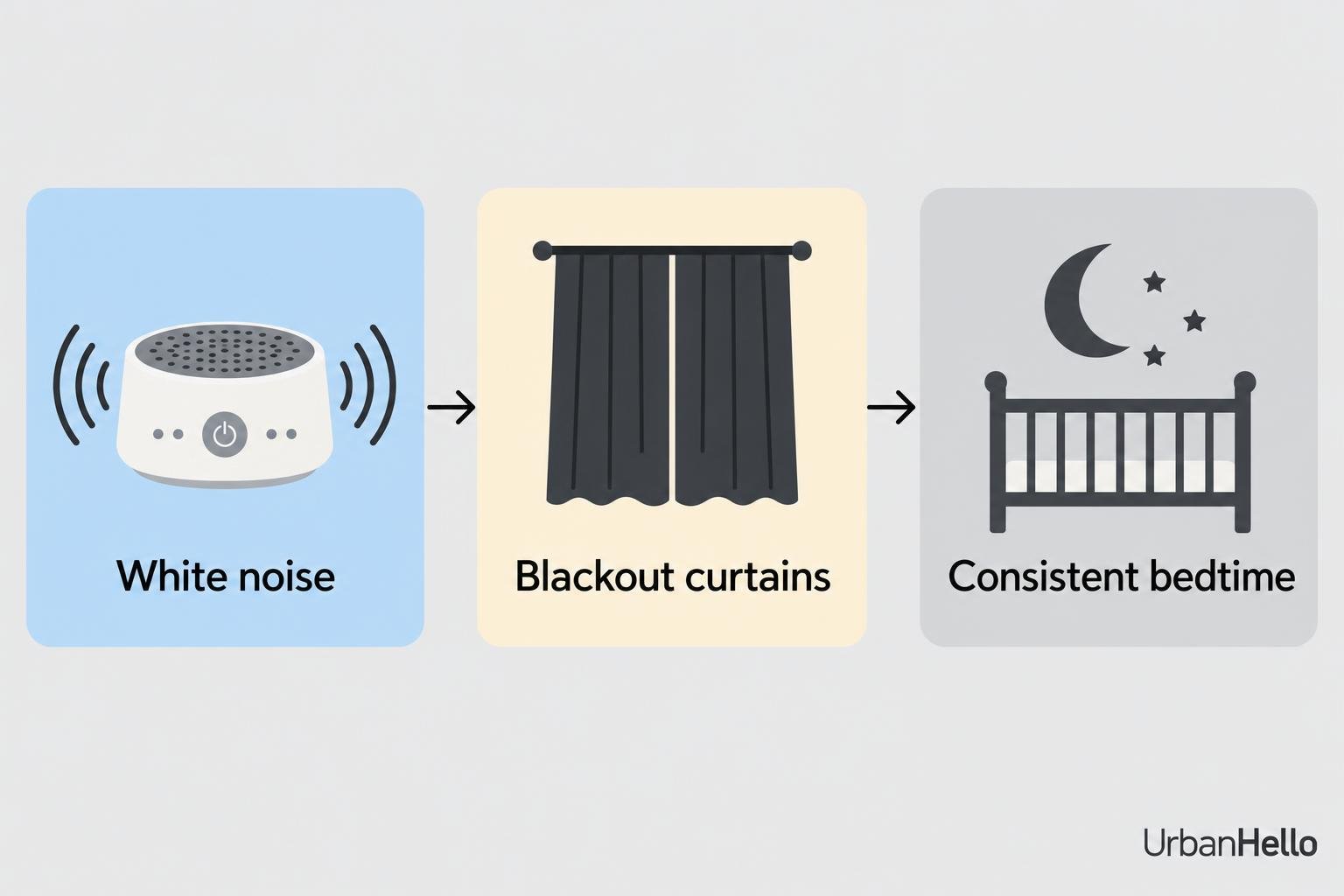
- Consistent bedtime routine A brief, repeatable sequence—feeding, pajamas, a book, a sleep sack, and the crib—signals that sleep is approaching and reduces the time needed to settle each evening.
- White noise A sound machine set to a steady level masks household sounds and maintains a consistent acoustic environment throughout the night, reducing the chance that external noise triggers a full arousal between cycles.
- Blackout curtains Darkening the room for naps and overnight sleep reduces light-triggered arousals, particularly in the early morning hours when sleep is naturally lighter.
- Daytime calorie loading Offering feeds every 2.5 to 3.5 hours during waking hours helps ensure the baby receives adequate nutrition before night, potentially reducing feeds driven by hunger rather than association.
Avoiding new sleep habits that require your constant presence at every wake-up is equally important. Offering comfort and reassurance is appropriate and necessary; creating an elaborate routine that must be repeated six times overnight is counterproductive. The aim is gentle sleep coaching that gradually reduces the baby's reliance on external support, within the limits of what is developmentally realistic at 4 months.
Monitor wakes without rushing in
One practical challenge during this phase is deciding, in real time and at 3 a.m., whether a sound from the nursery signals genuine distress or ordinary stirring between cycles. Rushing in at every sound can inadvertently interrupt a baby who was close to resettling independently. An audio baby monitor with clear sound quality supports this assessment by letting you distinguish active waking from ordinary stirring before you enter the nursery.
REMI's app-based monitor transmits audio over Wi-Fi, allowing you to listen, use two-way talk, and receive customizable sound notifications from anywhere you have connectivity: another room, another floor, or even outside the home. Its VOX (Voice Activated Alert) function activates the audio feed only when sound exceeds a defined threshold, reducing constant background noise and preserving battery life. Adjustable sensitivity means you can calibrate alerts to your baby's specific sounds: a lower threshold for detecting the first quiet stirrings of waking, and a higher one during more active periods.
REMI's two-way talk feature allows you to speak soothingly into the parent unit and have your voice play through the nursery speaker, sometimes settling a baby at the edge of waking without requiring you to enter the room. This quiet, low-intervention approach supports the baby sleep patterns you are working to establish and aligns naturally with giving your baby space to develop independent sleep, a skill that benefits the whole family long after the regression has passed.
When the sleep regression needs more help
However, some situations call for medical guidance, and knowing those thresholds prevents unnecessary delay.
When to call the pediatrician
Contact your baby's healthcare provider if sleep problems persist beyond 6 to 8 weeks without improvement, particularly if you have maintained consistent routines throughout. Disruption that seems extreme in intensity, or that exceeds the range that sleep regressions typically last and justify, warrants professional review. Your pediatrician can rule out medical causes and discuss whether developmental or behavioral sleep support is appropriate for your baby's age and temperament.
- Physical signs of illness Fever, unusual breathing during sleep, pain, or signs of infection alongside disrupted nights require prompt medical evaluation rather than a wait-and-see approach.
- Poor growth indicators If your baby shows inadequate weight gain, fewer than four or five wet diapers per day, or is missing developmental milestones, contact your pediatrician without waiting for sleep to improve on its own.
- Parental mental health Sleep deprivation at this level is genuinely demanding; if you feel your ability to cope safely is affected, reaching out to a healthcare professional is not only appropriate, it is necessary.
Regarding formal sleep training: most experts consider the 4-to-6-month window a reasonable starting point for discussion, though many advise waiting until at least 5 months before applying structured methods. At 4 months, young babies should not be left to fuss for prolonged periods. Sleep coaching at this stage is most effective when it is gradual, consistent, and respectful of the baby's developmental readiness.
A sleep companion beyond babyhood
What makes REMI particularly relevant beyond the acute regression is its animated face: a sleeping expression when it is time to rest, an awake expression when morning has arrived. For a baby navigating the unfamiliar experience of waking alone in a crib, this face becomes a recognizable and reassuring presence, a companion that is reliably there, night after night, building the familiarity that supports infant sleep and, later, independent sleep routines as the child grows.
As your child moves past infancy, REMI continues evolving alongside them. Beyond its role as an audio baby monitor and sleep regression support tool, it functions as a sleep trainer, walkie-talkie, story box with downloadable audio content, Bluetooth speaker, and classic alarm clock, designed to accompany children through age 10 and beyond. Its core monitoring features, including listening, two-way talk, sound notifications, and nightlight control, are available through the app without a required subscription, offering a clear long-term cost advantage over monitors that rely on recurring fees. Choosing one adaptable device from the earliest months avoids replacement purchases and meets changing sleep needs at every stage.
Choose REMI for growing sleep needs
The 4-month sleep regression is one of the first real tests of a family's sleep strategy, but it is far from the last. Sleep regression ages vary, disruptions are commonly noted again at around 8, 12, and 18 months, and each one benefits from a calm, consistent environment and a reliable monitoring tool. REMI is designed precisely for this continuity: it supports healthy sleep during the demanding early months and remains a trusted nighttime companion as your child develops their own sleep skills and eventually their own sense of morning independence.
If you are looking for a device that meets your baby's needs today, with clear audio, customizable alerts, two-way talk, and remote listening from anywhere, while growing with your child for years to come, REMI offers that full spectrum of support in a single, thoughtfully designed companion. The REMI companion can be purchased through the UrbanHello website, which provides a device suitable for children from birth to age 10 and beyond.
Frequently Asked Questions
The 4-month sleep regression is generally considered resolved when your baby's sleep becomes more predictable again: overnight stretches lengthen, naps extend beyond a single sleep cycle, and settling at bedtime becomes easier. Most families notice this gradual improvement within 2 to 6 weeks of the disruption beginning. If your baby is resettling more quickly after waking and is no longer waking more frequently than developmental norms suggest, the acute phase has likely passed. Continued consistency in your bedtime routine supports this transition and helps consolidate the baby sleep patterns that are now permanently established.
Most babies recover from this regression without formal sleep coaching, particularly when parents maintain consistent routines and a calm sleep environment. The underlying neurological change is permanent, but the frequent night waking it causes can diminish naturally as babies gradually develop the ability to bridge sleep cycles. Where disruption persists beyond 6 weeks, often because of strong sleep-onset associations such as feeding or rocking to sleep, gentle sleep training methods introduced from around 5 months can help the baby learn to settle independently. The right approach depends on your child's temperament, your family's values, and guidance from your pediatrician.
Many parents find the 4-month sleep regression particularly challenging because it often arrives without warning, after a period of relatively manageable nights, and reflects a permanent change in how their baby sleeps rather than a temporary disruption. It is the only regression directly tied to a biological shift in sleep architecture: the transition from newborn-style sleep toward more adult-like stages, which is why its effects can be more intense and longer-lasting than those of later regressions. Every baby's experience differs, and choosing the right monitoring tools and building strong sleep habits early can make subsequent regressions, at 8 months, 12 months, and beyond, significantly easier to navigate.
Share this article: