
How long does sleep regression last? A baby sleep guide


A sleep regression typically lasts from a few days to a few weeks, but the exact timeline depends on your child. This guide explains how long a sleep regression lasts at each stage, what causes it, how to keep it from dragging on, and when changes in sleep are worth raising with your pediatrician.
How long does a sleep regression last?
Parents often notice the change overnight. A baby who was falling asleep easily starts fighting bedtime or waking again and again. Knowing what a sleep regression period usually looks like helps you tell a passing phase from a problem that needs more attention.
Typical duration and uncertainty
So how long does a sleep regression last? It usually lasts from a few days to a few weeks. No single timeline fits every child, and research does not support one fixed clock. Three factors shape the duration:
- The cause: what disrupts sleep matters more than the child's age alone.
- Developmental changes: each developmental leap puts different demands on the brain and body.
- Caregiver response: calm, consistent reactions help sleep settle, while frequent changes in approach can prolong the disruption.
When disrupted sleep continues for months, calling it a regression no longer helps. It is more useful to look for what keeps the problem going, such as a sleep habit, the schedule or something in the environment.
What counts as a regression
« Baby sleep regression » is a parenting term, not a medical diagnosis. It describes a child who had been sleeping predictably and then begins waking more often, resisting naps or struggling to settle. The most common regression signs are:
- Frequent night waking: the baby wakes more often, even after nights that used to be steady.
- Shorter naps: daytime sleep becomes brief or broken.
- Daytime fussiness: the child is more irritable and needs more attention than usual.
- Changes in feeding: appetite and feeding times may change for a while.
These changes are a normal part of development. They do not mean you have done something wrong. Urban Hello explains the phases behind them in our guide to the signs of sleep regression in babies.
A changing normal
There is no peer-reviewed evidence that sleep regressions occur at the same ages for every child. Infant sleep develops very differently from one baby to the next, so a calendar of regression dates is only a rough guide.
Early irregularity is also not necessarily a regression. Newborns commonly sleep in stretches of one to two hours until regular sleep cycles develop at about 4 months, which is typical of the sleep patterns of a one-month-old baby.
When a temporary disruption ends, "normal" may look different from before. Your child may settle into a new sleep pattern instead of returning to the exact schedule they had.
The 4-month sleep regression timeline
The 4-month sleep regression reflects a real change in how a baby sleeps. Knowing what changes at this age helps you read the nights that follow and set expectations for how long the rough patch may last.
Why patterns reorganize
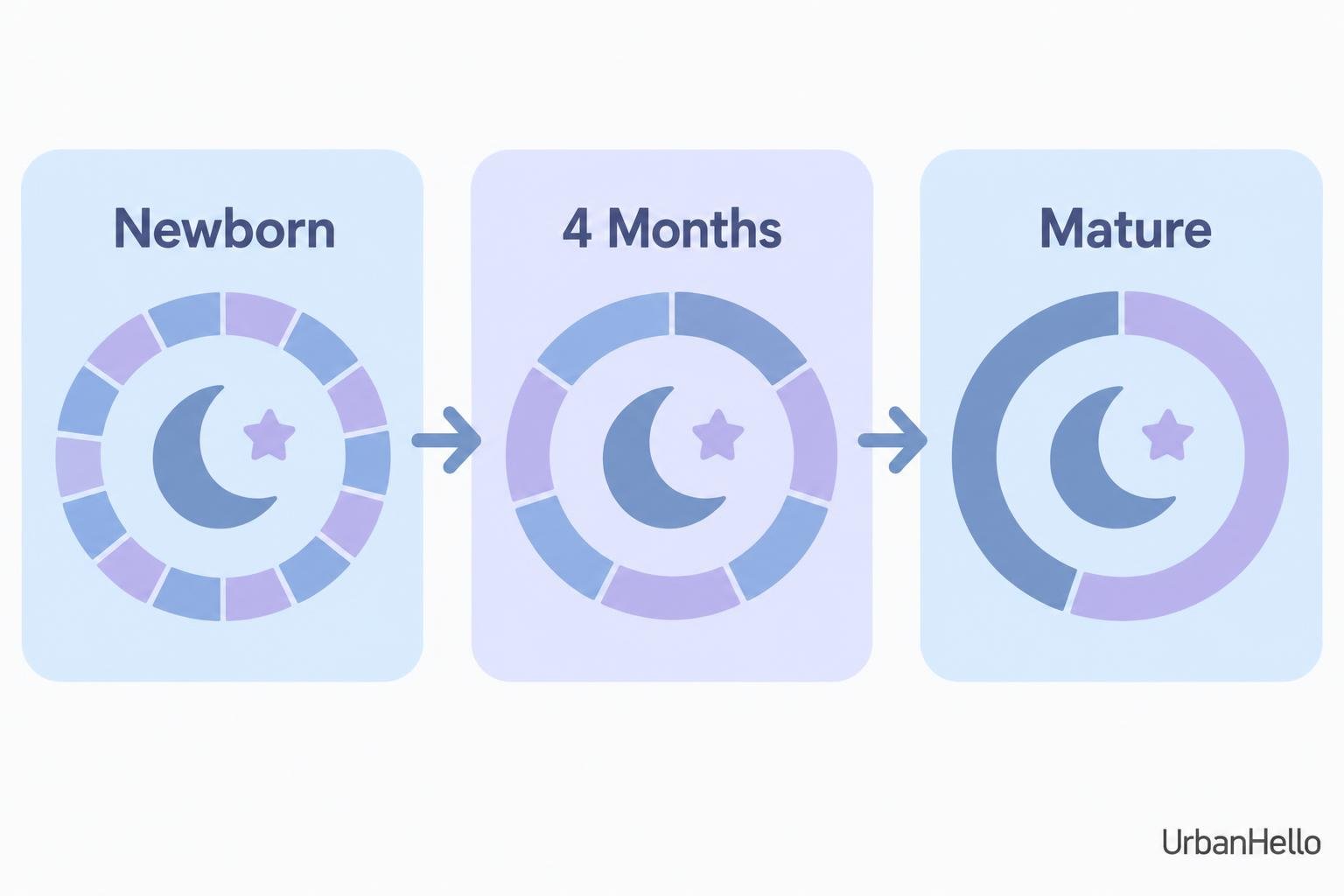
This regression commonly begins around 4 months. At this age, newborn-style sleep develops into more organized cycles. Each cycle now contains distinct stages:
- REM sleep: active sleep, when the baby may move, grimace or make small noises.
- Light non-REM sleep: a shallow stage from which the baby wakes easily.
- Deep non-REM sleep: the most restful stage, with steady breathing.
- Transitions between stages: short moments when the infant is still learning to move from one stage to the next without fully waking.
This shift, driven by brain development, is permanent. Only the unsettled adjustment period is temporary. It lasts while your baby learns to move smoothly between lighter and deeper stages.
Greater awareness of the world at this age also makes a child more reactive to noise and to changes in routine. A quiet, predictable room removes one source of disruption during this adjustment.
Baby sleep patterns at four months
For most babies, the acute phase lasts 5 to 15 days. However, the 4-month sleep regression has no clear end like a growth spurt does. Sleep usually gets easier gradually over the following weeks and months. At this age, babies generally need 14 to 18 hours of sleep in 24 hours. That includes roughly 10 to 13 hours at night and 5 to 7 hours during the day, spread across three to four naps.
What can happen next
The fifth month belongs to the broader transition from 4 to 6 months. It is not a separate, proven regression with its own fixed duration, so a few unsettled weeks around 5 months usually belong to the same change.
Daytime naps may last less than 45 minutes during this period. Your baby often wakes after one cycle because they are still learning to link cycles together.
A 4-month-old may also still need 0 to 3 night feeds. These feeds are developmentally normal and are not a sleep problem you need to eliminate.
Later sleep regression timelines
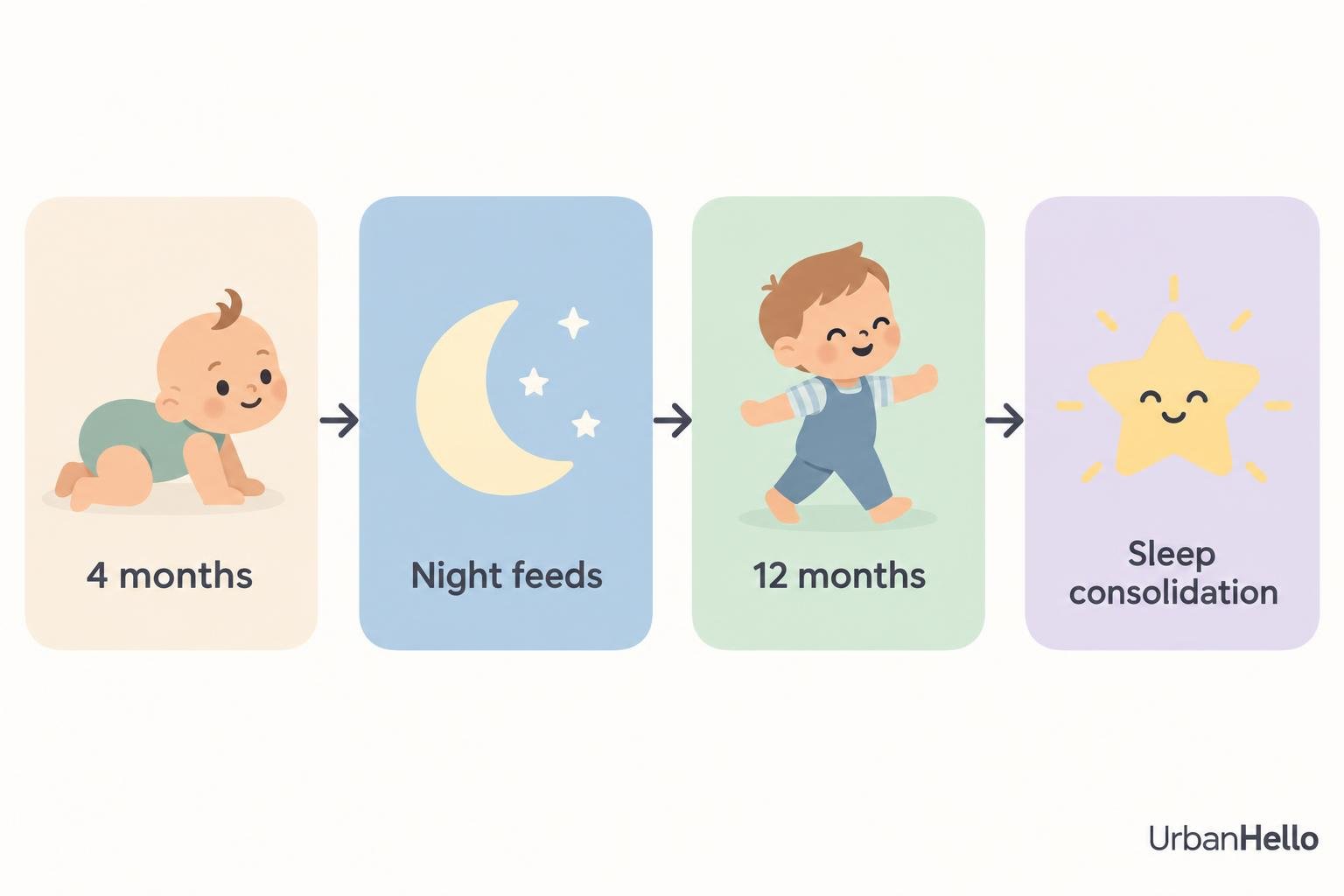
After 4 months, the commonly cited sleep regression ages tend to line up with new motor, cognitive and emotional skills. Each stage has its own triggers, and some of these influences last longer than the regression itself.
Six to ten months
According to the American Academy of Pediatrics, it can be normal for a 6-month-old to wake during the night and fall back asleep after a short time. Between about 7 and 10 months, disrupted sleep often coincides with:
- New mobility: crawling and pulling up to stand, which babies sometimes practice in the crib.
- Cognitive development: fast learning that keeps the brain busy.
- Teething: a common, visible change parents often link to bad nights.
- Nap transition: going from three naps a day to two.
Separation anxiety can disturb sleep for several months and often fades around the second birthday. Because of that, it can last well beyond a regression defined by a single age.
Around the first birthday
A disruption around 12 months usually lasts no more than a few weeks. It is often linked to learning to walk, developing language, new separation behaviors or schedule changes.
A baby who resists naps at this age may need a longer awake period before the nap. That does not necessarily mean they are ready to drop the nap altogether.
Between 8 and 14 months, babies generally still need two naps a day. Moving to one nap too early can leave your child overtired, which makes both nap time and bedtime harder.
Eighteen months to age two
The 18-month sleep regression rarely lasts more than a few weeks. When separation anxiety returns, your toddler may need extra reassurance along with consistent, calmly held boundaries.
According to UCLA Health, a sleep regression around age 2 generally resolves within a few weeks. At age 2 or 2 and a half, sleep can be disrupted by potty training, a new sibling, starting school, moving to a toddler bed, fear of the dark or separation anxiety.
Recommended products

Shorten a dragging sleep regression
No single fix ends a regression. You can, however, avoid making it last longer. How you respond each night, how your child learns to fall asleep and whether their schedule fits their age all affect how quickly calmer nights return.

Keep the response predictable
For a short disruption lasting 1 to 3 nights, keep your current schedule, comfort your child and leave the routine unchanged. Many difficult patterns settle on their own. A consistent bedtime routine repeats the same calm steps in the same order: feeding, bath, diaper change, pajamas, then a story or lullaby.
At night, keep your responses quiet and low in stimulation. REMI sends customizable sound notifications and lets you listen or talk through the app from anywhere with a connection. A soft word through the speaker can sometimes settle a baby who is half awake without you going into the room.
Rebuild independent settling
If you start feeding, rocking or holding your child all the way to sleep when you didn't before, frequent waking can last longer. Your child may start expecting the same help between cycles. From around 4 months, when your baby is developmentally ready, the American Academy of Pediatrics recommends putting them down drowsy but awake. That way, they practice falling asleep in the same conditions they will wake up in.
Some families choose a more structured method. In a randomized trial of 43 infants aged 6 to 16 months, published in a scientific journal, graduated extinction and bedtime fading both improved settling and night waking. At 12 months, neither method had adverse effects on attachment or on emotional and behavioral outcomes.
Check timing and environment
Keep a sleep log for 3 to 7 days. Note bedtime, the time your child actually falls asleep, naps, night wakings, feeds and any disruptions. The trend across several nights tells you more than one hard night does.
Timing matters too, especially wake windows, meaning the time your child spends awake between two sleeps. These are practical estimates, not targets to stretch. For every sleep until age 1, place your baby on their back on a firm surface with no loose bedding. This reduces the risk of sleep-related infant death.
| What to check | Guideline | Why it matters |
| Brief disruption | 1 to 3 nights: keep the same schedule | Many difficult patterns settle on their own |
| Sleep log | 3 to 7 days | Shows trends instead of single nights |
| Wake window early in the day (about 4 months) | About 90 minutes | Helps prevent overtiredness |
| Wake window before bedtime (about 4 months) | Closer to 120 minutes | Makes settling easier |
| Safe sleep position | On the back, firm surface, until age 1 | Reduces the risk of sleep-related death |
When prolonged sleep needs medical advice
Most disrupted nights pass with time. Some signs, though, point to something other than a normal developmental phase. Recognizing them, and ruling out common alternative causes, helps you know when to call your pediatrician.
Signs to call the pediatrician
A regression is temporary and gradually improves. Other patterns call for a medical opinion instead:
- Sleep getting worse: contact your pediatrician before starting sleep training if disrupted sleep is worsening or comes with other symptoms.
- Problems that persist: sleep problems that continue into later childhood, beyond a typical temporary window, are worth discussing.
- Fewer wet diapers: after the first 4 to 5 days of life, babies typically wet at least five or six diapers a day, so a clear drop deserves medical advice.
Your pediatrician can look at these signs together and determine whether another problem is keeping your baby from sleeping well.
Rule out other causes
Teething is often blamed for bad nights. However, a 2025 objective study of 849 infants aged 3 to 18 months found no significant difference in measured sleep between teething and non-teething nights, even though many parents reported disturbed sleep. According to the American Academy of Pediatrics, teething can cause tender gums, drooling, chewing and mild irritability. Fever, diarrhea or heavy crying should not simply be attributed to teething.
A growth spurt can increase feeding needs for a few days. Illness, schedule changes and physical discomfort can also explain a sudden change in sleep.
Track trends and choose REMI
Consumer sleep technology cannot diagnose or treat sleep disorders. Still, several nights of observations make your conversation with a clinician more specific. REMI's Night Tracking estimates bedtime and wake-up time from room noise and displays them on a timeline. This helps you spot repeated links between waking and room conditions, alongside your own notes.
REMI's face shows a sleeping or awake expression, making it a reassuring companion that watches over your child's nights. It also works as a baby monitor, sleep tracker, walkie-talkie, story box, Bluetooth speaker and alarm clock, so your child can keep using it from birth through age 10. Choose REMI on UrbanHello to support healthy sleep routines for years to come.
Frequently Asked Questions
The change in sleep structure at 4 months is permanent, but the difficult period is temporary. Most babies settle into smoother sleep over the following weeks and months.
When a sleep problem lasts for months, it is more useful to find out what keeps it going than to keep calling it a regression. A baby who depends on being fed, rocked or held to fall asleep may keep waking until they learn to settle independently. New sleep crutches can also make a regression last longer.
According to the American Academy of Pediatrics, it can be normal for a 6-month-old to wake at night and fall back asleep quickly. Separation anxiety can affect sleep for several months and usually fades around the second birthday.
Share this article: